


Off-plan in Dubai means you buy from the developer before the building exists, or while it is still going up. The pull is easy to see: lower entry prices, staged payments, brand-new stock, and the chance the unit is worth more by the time you get the keys. What the brochures skip is the other half. Timelines slip. Market conditions turn. Execution quality is never a given. The one thing Dubai does better than most markets is structure the process, so off-plan sales run through project registration, provisional registration, and escrow controls rather than a handshake.
If you plan to exit before handover, read our Dubai real estate investment assignment strategy, which runs the full arithmetic.
Once you know the process, the next step is stock: we keep a live list of Dubai off-plan properties you can filter by area, developer and payment plan.
So, can off-plan make sense here? Yes, often a lot of sense, for investors and end users both. But only when the deal lines up with the right developer, the right location, and a cash-flow plan you can actually sit through. Most guides stop at “cheaper prices, flexible payments” and call it done. That is true and useless. The question that matters is whether the project has a credible delivery path, a payment structure that does not squeeze you, and real demand once handover arrives.
What off-plan actually means
You are committing to a future asset, not a home you can walk through today. The evidence you buy on is a package: floor plans, where the unit sits in the masterplan, the developer’s record, the payment schedule, the specs, and the legal paperwork that governs delivery. Sometimes the project is pre-launch. Sometimes construction has started. That gap matters. Pre-launch pricing can be sharper, but the certainty is thinner than a project you can see rising on site.
Which is why “off-plan” should never be treated as one category. Buying into a flagship waterfront masterplan from an established name is not the same risk as a first-time boutique launch with almost no track record to check. Both can work. I have seen both work. They are not remotely the same bet.
Why buyers go off-plan here
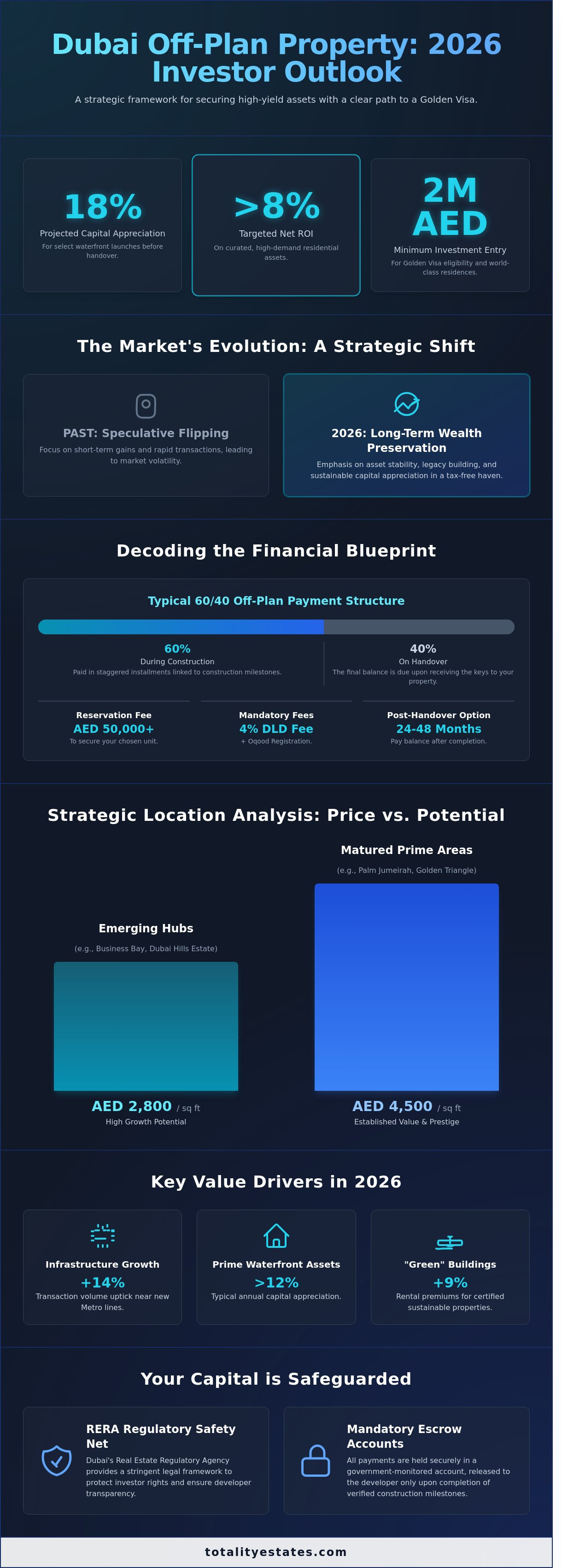
Four reasons keep coming up, and they come up because they are the four that count: lower launch pricing, installment payments, new stock, and the chance of appreciation before handover.
1. Lower entry pricing
Developers usually price early inventory below comparable finished stock, or at least below where they expect it to trade once construction advances and handover nears. That gap is why seasoned investors go in early. It is not free money, nothing here is, but it does leave room for upside if the project is well chosen.
2. Payment plans
This is the practical one. Instead of funding the whole purchase upfront, you pay in stages tied to dates or construction milestones. Many Dubai projects still open with a booking of 10 to 25 percent, then construction-linked payments, then a final tranche at handover, and some add post-handover structures on top.
3. Newer product
New launches are designed around what buyers want now: bigger amenity packages, smarter layouts, better common areas, cleaner parking flow, wellness positioning. Some of that is marketing. But newer stock does line up better with current tenant expectations than a tired unit in a mediocre building.
4. Appreciation before handover
If the area improves, the developer delivers, and demand holds, an off-plan buyer can see the price move up during construction. That is the reason serious investors use off-plan as a tool rather than an impulse. They are buying time, price position, and optionality, not just a home.
Is off-plan in Dubai safe?
Safer than most overseas buyers assume, but safe is not the same as automatic. Dubai Land Department holds buyer money for off-plan units in project escrow accounts, meant to regulate construction and protect investor rights. Developers register off-plan sales in the provisional register, and Dubai REST lets you track completion percentage, actual project photos, the escrow account number, and payments due. That is real infrastructure, not brochure language.
The catch is that the protection only works if you use it. Check the project status. Verify the developer. Read the SPA properly. Understand what happens on a delay, a variation, a cancellation. Too many buyers lean on the sales pitch when the real safety net is sitting in the documents and the registration trail.
What it costs upfront
Off-plan lowers the entry barrier compared with ready property, true. But there are still costs to budget for.
- Reservation or booking amount, often 10 to 25 percent
- Dubai Land Department registration fee
- Administrative or trustee-related charges, depending on the structure
- Possible Oqood or initial registration charges
- Agency fee, if applicable
- Service charges after handover
Under Dubai’s fee schedule, the registration fee for a real property sale contract is 4% of the sale value. DLD legislation says that unless otherwise agreed, the fee is shared equally by seller and purchaser, though in practice deal structures vary. DLD service pages show service partner fees commonly at AED 4,000 plus VAT for values at or above AED 500,000, and AED 2,000 plus VAT below that. RERA’s service charge index lets you check approved service fees for jointly owned property.
Off-plan vs ready property
| Feature | Off-Plan Property | Ready Property |
|---|---|---|
| Purchase timing | Before or during construction | Already completed |
| Entry price | Often lower at launch | Usually higher |
| Payment structure | Installments, milestone-based | Larger upfront payment or mortgage |
| Rental income | Only after handover | Can start immediately |
| Product condition | Brand new | Existing condition, may need upgrades |
| Main risk | Delay, specification variance, execution | Overpaying, older building, maintenance exposure |
| Best for | Investors with a time horizon, strategic end users | Buyers needing immediate use or income |
The distinction is well worn, but the real-life choice is less theoretical than people make it. Need immediate cash flow? Ready property usually wins. Want price position and can wait? Off-plan is often the stronger move.
Where off-plan demand concentrates
The areas most buyers circle are the expected ones: Business Bay, Downtown Dubai, Dubai Hills Estate, and established master communities with strong branding and infrastructure behind them. There is a second layer serious investors watch harder, the emerging waterfront and masterplan-led districts where future place-making does a lot of the heavy lifting.
That is one reason
Dubai Islands
keeps coming up. It sits where beachfront scarcity, masterplan scale, and early-cycle pricing meet. If you are comparing waterfront off-plan, it is worth reading the
Dubai Islands master plan guide
and this more detailed
Dubai Islands investment deep dive before you narrow a shortlist.

How to buy off-plan, step by step
The word off-plan sounds simple until the paperwork starts arriving. In practice the sequence is fairly consistent across projects, even where developers vary in how they present forms, timelines, or payment instructions. DLD’s own framework shows the building blocks: project registration, provisional registration for initial sales, escrow-linked oversight, and buyer visibility through Dubai REST.
Step 1, decide the objective before you open a brochure
Sounds obvious, and it is where most buyers go wrong. Is this for capital appreciation, future end use, or rental income after handover? Those three goals point you toward different communities and even different developers. An investor chasing early-cycle appreciation may be fine with a longer hold in a newer masterplan. Someone who wants predictable end-user demand may prefer an established location, even if the upside is tamer. I do not start with the project. I start with the outcome. Once that is clear, the shortlist gets a lot smarter.
Step 2, verify the developer, the broker, and the project
Before you reserve anything, confirm the developer is approved, the broker is licensed, and the project is registered. DLD provides public services for viewing licensed brokers, approved developers, and project status, and its brokerage practice guide notes you can validate a project through the Dubai REST app via Mashrooi. A polished presentation is not the same as regulatory readiness. A famous brand helps, but I would still check the project status rather than assume.
Step 3, reserve the unit
Once you pick the unit, you pay a booking amount and submit your documents, typically a passport copy for all buyers, plus Emirates ID and visa copy if you are UAE-based. At this stage, do not fixate on the unit number and the price. Check the exact layout, floor, view orientation, parking allocation, payment schedule, expected completion date, and the wording around material changes. Small details here become large ones later.
Step 4, sign the SPA
The Sale and Purchase Agreement governs the transaction, and this is where the real logic of the deal lives. Review payment dates, default clauses, the estimated completion timeline, handover conditions, specification language, and how delays or amendments are treated. After signing, the developer registers the initial sale in the provisional register for off-plan units not yet fully paid, which DLD’s initial sale registration service handles directly. The SPA matters more than the showroom. Buyers usually do the reverse, falling for the showroom and skimming the contract.
Step 5, pay through the approved structure
Dubai requires project escrow controls for off-plan. DLD’s FAQ states the escrow account law applies to developers selling units off-plan and receiving payments, and its investor-rights guide explains buyer money must be deposited into the project escrow account with an accredited escrow agent. For you, the takeaway is simple: know where your money is going, what milestone it corresponds to, and whether the payment request matches the schedule. Do not treat installment notices like ordinary invoices. They are part of your risk management.
Step 6, monitor properly
Dubai REST gives off-plan investors live project information, completion percentage, actual photos, escrow account number, payments due. It is one of the more useful and underused tools in Dubai’s system. A passive off-plan buyer is exposing themselves for no reason. The system already hands you the visibility. Use it.
Step 7, prepare for handover, snagging, and operations
As completion nears, get ready for the final payment, the snagging inspection, a service charge review, a furnishing strategy if you are letting, and the operational setup. This is the moment you find out whether you bought an asset or a nice-looking idea. Finishing quality, common areas, elevators, access flow, facade ageing, and the actual usable layout all turn real. It is also why I like looking at a developer’s completed stock before recommending their new launches. Handover reveals the truth of the brand.
Can foreigners buy off-plan in Dubai?
Yes. Non-UAE nationals can own property in designated areas. DLD’s FAQ says properties for non-UAE citizens may be registered in the areas specified under the real estate registration framework, and its investor-rights material explains designated areas allow freehold ownership or other real property rights for foreigners. For most international buyers, the real question is not whether they can buy, but whether the specific project sits in a freehold area with a clear ownership and registration path. For mainstream launches in established zones, that is usually straightforward.
Due diligence checklist
Here is the checklist I would actually use.
| What to Check | Why It Matters | Where to Verify |
|---|---|---|
| Developer approval | Confirms the developer is recognized in the system | DLD approved developers list |
| Broker license | Reduces intermediary risk | DLD licensed brokers service |
| Project registration | Confirms the project is visible in the system | Dubai REST / Mashrooi |
| Escrow account | Key buyer protection mechanism | DLD FAQ and investor rights guide |
| Payment schedule | Affects cash flow and risk | SPA and developer documents |
| Layout efficiency | Impacts future resale and leasing | Floor plans and comparable stock |
| Completion risk | Influences timing and exit strategy | Project status and developer track record |
| Service charges | Affects net yield after handover | RERA service charge index, if applicable |
The risks, and how to cut them
Most off-plan guides mention delays, market movement, and the gap between marketing and delivery. Accurate, and incomplete. The real risks are more granular.
Risk 1, construction delay
Pick developers with a stronger track record, check project status in Dubai REST, and read the SPA’s delay language carefully.
Risk 2, weak layout or usability
Look at net usable space, balcony loading, kitchen practicality, storage, parking, and tower positioning, not just the headline square footage.
Risk 3, overpaying at launch
Compare the launch price not only to today’s resale, but to where the finished product will realistically sit once service charges, competition, and delivery quality are factored in.
Risk 4, buying the wrong location cycle
Focus on infrastructure, masterplan credibility, and long-term demand, not marketing urgency.
If waterfront growth corridors are your angle, these two pieces on
Dubai Islands as an investment play and
Dubai Islands to 2030
are worth reading alongside this guide.
The developers buyers compare
The names that dominate Dubai off-plan searches are Emaar, Nakheel, Meraas, Sobha Realty, and DAMAC. Emaar across communities like Downtown Dubai, Dubai Hills Estate, and Dubai Creek Harbour. Nakheel across large-scale destinations including Dubai Islands. Meraas through master developments across the city. Sobha through luxury residential and off-plan inventory. DAMAC through a broad portfolio of luxury product.
| Developer | Common Buyer Perception | Why Buyers Look |
|---|---|---|
| Emaar | Blue-chip, broad market confidence | Established communities and strong brand presence |
| Nakheel | Masterplan and waterfront appeal | Large-scale place-making, including Dubai Islands |
| Meraas | Lifestyle-led product | Strong design and destination positioning |
| Sobha Realty | Build-quality focus | Premium finish expectations |
| DAMAC | High-visibility branded and luxury product | Strong launch presence and broad investor awareness |
One caution. The developer name matters, but not on its own. Even strong developers ship projects that are better or worse relative to price. Brand helps. It does not replace underwriting.
If you are comparing inventory, review
off-plan apartments for sale in Dubai
and, if waterfront scarcity is part of the thesis, the broader
Dubai Islands area guide.
Best areas for off-plan
No single off-plan area suits every buyer, which is where broad guides go generic. A strong purchase comes from matching the community to the objective. Some places work for prestige and liquidity. Others for family end use. Others, especially waterfront masterplans, for buyers who want in earlier in the cycle.
Downtown Dubai
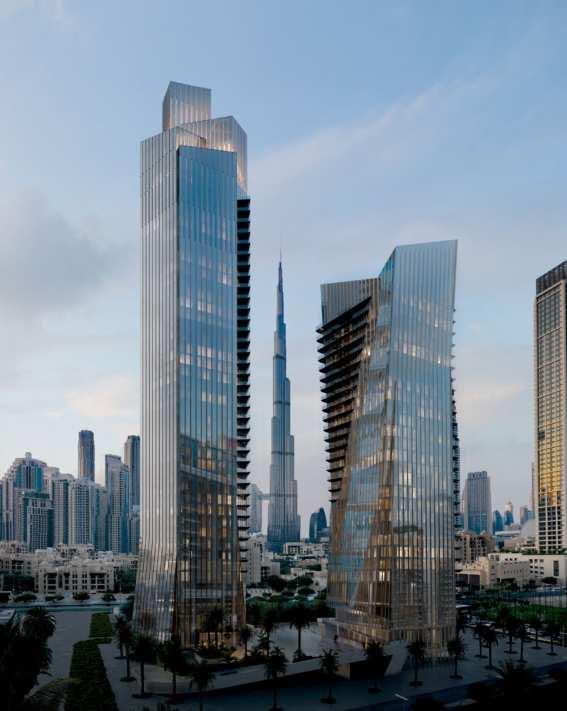
One of the most recognizable residential districts in the city, tied directly to Burj Khalifa and the Emaar core. For buyers that means brand recognition, international appeal, and a deep resale pool. It is rarely the cheap-entry play. It can be a stronger liquidity play than many cheaper districts.

Dubai Hills Estate
It keeps pulling both investors and end users because it pairs a large masterplan with parks, a golf course, schools, and retail, and a more balanced liveability than tower-heavy districts. Emaar’s own pages lean on the green setting, mixed housing, and ongoing off-plan pipeline, which is why it stays on shortlists.

Arabian Ranches III
A different kind of off-plan buy. More family-oriented, lower density in feel, better suited to buyers who value space and long-term end use over quick rental velocity from a small apartment. Emaar positions it as a lifestyle-led, family-friendly community of contemporary villas and townhouses.

Business Bay
A core investor location thanks to its position beside Downtown and its mixed-use character. It suits buyers who want dense-city convenience, strong tenant demand, and a large pool of apartment product. I would still be selective, because tower quality, traffic flow, service charges, and exact canal or core positioning can swing the investment case a lot from one building to the next.
Dubai Islands
It stands out for a different reason. Nakheel describes it as a waterfront destination of five islands with resorts, beaches, and cultural hubs, aligned with Dubai’s 2040 vision. For off-plan buyers, that mix of masterplan scale, waterfront scarcity, and early-cycle positioning is exactly why it has moved into serious investor conversations. It is not the thesis of buying a finished tower in a mature district. It is about where the area sits once the wider ecosystem fills in.

If you are evaluating coastal masterplan opportunities, these guides deepen the comparison:
Dubai Islands area guide,
Dubai Islands master plan guide, and
Dubai Islands to 2030 forecast.
Which area suits which buyer
| Area | Best For | Why Buyers Consider It |
|---|---|---|
| Downtown Dubai | Prestige-focused buyers, global investors | High visibility, global recognition, strong resale audience |
| Dubai Hills Estate | Balanced investors and end users | Green community, broad appeal, strong masterplan credibility |
| Arabian Ranches III | Families, villa and townhouse buyers | Lifestyle-led community, more space, end-user stability |
| Business Bay | Urban-core investors | Central location, apartment stock, mixed-use demand |
| Dubai Islands | Waterfront, early-cycle investors | Masterplan upside, coastal scarcity, destination-led positioning |
A simplified table, admittedly. Real decisions still turn on unit type, tower position, service charges, developer execution, and payment structure. As a first filter, though, it holds up.
Off-plan vs ready on ROI
Off-plan can beat ready property when you enter at the right price, in the right project, and give the asset enough time to grow into its pricing. Ready property can beat off-plan when immediate rental income, known building performance, and shorter holding uncertainty matter more than early-stage appreciation.
Off-plan tends to work best when
- you want staged capital deployment rather than full upfront funding,
- you are buying a credible project before pricing fully catches up,
- you can wait for handover,
- you believe the district itself will improve materially during construction.
Ready property tends to work best when
- immediate rental income matters,
- mortgage leverage is central to the strategy,
- building quality can be inspected now,
- you prefer lower timeline uncertainty.
| Factor | Off-Plan | Ready |
|---|---|---|
| Immediate income | No | Yes |
| Entry price advantage | Often better | Usually lower upside at entry |
| Certainty of product | Lower | Higher |
| Ability to inspect actual asset | No | Yes |
| Appreciation during build | Possible | Less relevant |
| Timeline risk | Higher | Lower |
One honest framing: off-plan is usually the stronger positioning play, ready property the stronger cash flow now play. Not universal, but true often enough to matter.
Common mistakes with off-plan
Buying the brochure, not the deal
A beautiful render is not due diligence. Focus on the SPA, the payment schedule, the actual layout, the developer’s delivery history, and the registration trail. DLD’s framework makes project and escrow visibility accessible, so there are fewer excuses for blind decisions than there used to be.
Ignoring the payment structure
Two projects with similar headline prices can create very different pressure depending on when installments fall. A cheap launch is not cheap if the payments are front-loaded and aggressive.
Assuming all major developers are interchangeable
They are not. Brand matters, but each project still has to be judged on product quality, price position, and the likely experience at handover.
Treating all locations the same
A Business Bay tower, an Arabian Ranches III townhouse, and a Dubai Islands waterfront apartment should not be judged on the same end-user logic.
Forgetting the post-handover reality
Service charges, furnishing costs, leasing strategy, snagging, and building operations can move returns materially after completion.
Frequently asked questions
Is buying off-plan in Dubai legal and regulated?
Yes. DLD provides services for project registration, initial sale registration, project status monitoring, and escrow-linked oversight for off-plan projects.
Can foreigners buy off-plan in Dubai?
Yes, non-UAE nationals can buy in designated areas under Dubai’s ownership framework.
How much deposit is usually needed?
Many projects start with a 10 to 25 percent initial payment, then a staged plan. It varies by developer and project.
How do I know if a project is genuine?
Verify the developer, the broker, and the project through DLD tools and Dubai REST.
What is Oqood or provisional registration?
DLD’s initial sale registration covers the provisional registration of off-plan sales before full completion and final title issuance.
Is off-plan better than ready property?
It depends on your objective. Off-plan usually suits buyers after early pricing and staged payments. Ready property usually suits buyers after immediate usability and income.
The bottom line
Off-plan in Dubai can be a smart move, sometimes an exceptionally smart one, but only when you treat it as a structured investment decision rather than a showroom purchase. The advantages are real: lower entry pricing, milestone payments, modern stock, and the chance of meaningful appreciation before handover. So are the protections, with project registration, escrow controls, and visibility tools from DLD and Dubai REST. The variable that decides the outcome is selection. The right developer, the right community, the right payment plan, and the right hold can make off-plan work extremely well. The wrong combination creates friction even in a regulated market.
For coastal and masterplan-led opportunities, these pages are worth reading next:
off-plan apartments for sale in Dubai,
Dubai Islands area guide, and
Dubai Islands investment deep dive.