
The Dubai property market
in March 2026
|
Sales Volume
13,509
▼ 20.8% MoM
▼ 11% YoY
|
Price / sqft
1,740 AED
0% MoM
▲ 9% YoY
|
Sales Value
43.5B AED
▼ 28.5% MoM
▼ 8.1% YoY
|
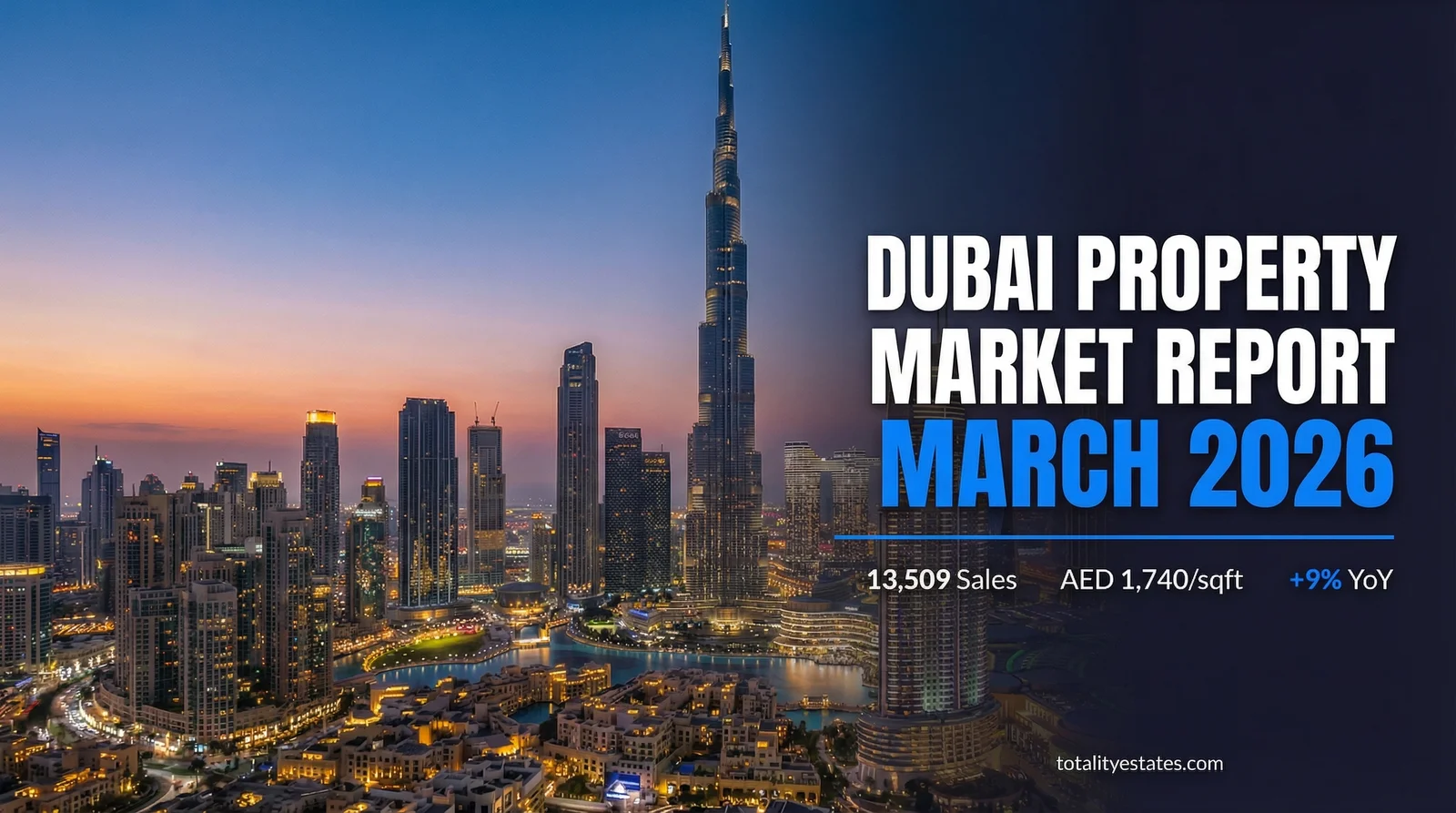
The Dubai property market in March 2026 looked softer on a month-to-month basis, but the broader picture still points to a market that is expanding, not reversing. DXB Interact’s March dashboard shows 13,509 sales, a median price of AED 1,740 per sq ft, and AED 43.5 billion in sales value. At the same time, quarter-wide reporting still showed strong momentum, with Q1 2026 reaching AED 176.7 billion across 47,996 transactions, and off-plan making up roughly 70% of total activity. In practical terms, March felt more like a pause after a very strong run, not a collapse.
Market snapshot, March 2026 at a glance
The table below combines the March monthly dashboard with quarter-level reporting referenced by major UAE publications.
| Metric | March 2026 | What it suggests |
|---|---|---|
| Total sales volume | 13,509 | Activity cooled versus February, but remained substantial |
| Median price per sq ft | AED 1,740 | Pricing held firm even as volume eased |
| Total sales value | AED 43.5B | Lower than February, still a very large monthly total |
| Q1 sales volume | 47,996 | The quarter remained strong overall |
| Q1 sales value | AED 176.7B | Capital deployment stayed deep |
| Off-plan share of Q1 volume | 70% | New-launch and early-cycle demand still dominates |
| Off-plan share of Q1 value | 71% | Buyers are still allocating heavily into primary stock |
The first thing to understand, March was softer, but not weak
This is probably the point many articles miss. A drop from February does not automatically mean the market turned negative. In Dubai, and really in most active property markets, monthly numbers can look dramatic when the base month was unusually high. DXB Interact’s March dashboard shows exactly that kind of cooling: sales volume was down 20.8% month on month, sales value was down 28.5% month on month, but the citywide median price per sq ft was still AED 1,740, effectively flat month on month and up 9% year on year.
So the cleaner interpretation is this: transaction pace slowed, pricing did not really crack.
|
Volume MoM
▼ 20.8%
Transaction count fell
|
Price / sqft MoM
0%
Pricing held firm
|
Price / sqft YoY
▲ 9%
Up year-on-year
|
That matters. Quite a lot, actually. When volume falls sharply and pricing falls with it, that is a different conversation. But when deals slow and values per sq ft stay relatively firm, it usually points to a market digesting earlier gains, or simply moving through a seasonal and calendar-driven pause, rather than entering a deep correction. Khaleej Times also reported that brokers were viewing March softness through the lens of seasonal factors, including Ramadan, Eid timing, school breaks and wider geopolitical caution, while still describing the underlying market as fundamentally steady.
Prices are still telling a healthier story than the raw volume headlines
The pricing tables in the March dashboard are quite revealing. In the primary market, median prices stood around AED 1.4M for apartments, AED 4M for villas, and AED 5.3M for plots in March. Compared with 2025, that meant apartments were up 4.7%, villas up 22.1%, and plots up 52.5%. On the resale side, median prices were approximately AED 1.3M for apartments, AED 4.3M for villas, and AED 8.3M for plots. Resale villas were up 18.1% versus 2025, while resale apartments were up 2.6%.
| Type | Median | vs. 2025 | vs. 2014 |
|---|---|---|---|
| Apartment | AED 1.4M | ▲ 4.7% | ▲ 21.6% |
| Villa | AED 4.0M | ▲ 22.1% | ▲ 16.4% |
| Plot | AED 5.3M | ▲ 52.5% | ▲ 1.7% |
| Type | Median | vs. 2025 | vs. 2014 |
|---|---|---|---|
| Apartment | AED 1.3M | ▲ 2.6% | ▲ 9% |
| Villa | AED 4.3M | ▲ 18.1% | ▲ 21.1% |
| Plot | AED 8.3M | ▼ 11.9% | ▲ 37.9% |
That is not the profile of a market rolling over.
And yes, there are nuances. Plot pricing is always more volatile, and villas have clearly outperformed apartments in several parts of the cycle. Still, the broader takeaway is that Dubai entered March 2026 with pricing power still visible across key segments, particularly villas and selected land-led opportunities.
A separate Q1 summary reported by Gulf News said average residential prices reached AED 1,949 per sq ft, with off-plan apartments at AED 2,100 per sq ft and secondary villas at AED 2,354 per sq ft, reinforcing the idea that higher-value stock and more premium inventory continue to shape overall transaction value.
Apartments are still the volume engine, villas are still where pricing is hotter
This is another distinction worth making because it helps the article feel more useful, not just descriptive.
The March dashboard shows apartments leading overall activity with 10,687 apartment transactions and AED 22.3 billion in value. Villas followed with 2,231 transactions worth AED 14.5 billion. Commercial assets recorded 412 deals worth AED 2.2 billion, while plots accounted for 175 transactions worth AED 4.5 billion.
|
Apartments
10,687
transactions
AED 22.3B
|
Villas
2,231
transactions
AED 14.5B
|
Commercial
412
transactions
AED 2.2B
|
Plots
175
transactions
AED 4.5B
|
| Apartments 79% | Villas 17% | 4% |
So apartments remain the market’s volume engine. That is not surprising. They are generally more accessible, easier to absorb, and central to off-plan supply pipelines. Villas, however, continue to carry stronger scarcity-driven pricing momentum in many parts of Dubai, particularly where family demand, end-user upgrades and larger-ticket investor appetite overlap. Khaleej Times’ Q1 data points in the same direction, reporting 36,428 apartment sales worth Dh75.2 billion and 8,261 villa sales worth Dh59.1 billion, with villa volumes and values showing especially strong movement year on year.
In plain English, apartments are still doing the heavy lifting on count, but villas are where pricing pressure feels more intense.
Where the demand is concentrating
The most useful market reports do not just tell you that Dubai is up or down. They tell you where the demand is flowing.
The March top-performing areas by transaction volume were Dubai South, Al Barsha South Fourth, Wadi Al Safa 5, Al Yelayiss 1, and Wadi Al Safa 3. Khaleej Times’ Q1 reporting echoed the same broad pattern, highlighting Al Barsha South Fourth, Dubai South, Al Yelayiss 1, Wadi Al Safa 5, and Wadi Al Safa 3 as the main volume leaders across the quarter.
|
1
|
Dubai South | |
|
2
|
Al Barsha South 4 | |
|
3
|
Wadi Al Safa 5 | |
|
4
|
Al Yelayiss 1 | |
|
5
|
Wadi Al Safa 3 |
That cluster tells us something important. The market is not being carried only by legacy prime districts. A large part of today’s demand is still concentrating in emerging communities, affordability corridors, and off-plan heavy zones where buyers can still access new stock, payment plans and future-growth narratives.
This is exactly why area-led reading matters.
Early read on what March 2026 really means
My view, and I think the data supports it, is that March 2026 was a normalization month inside a still-bullish medium-term trend. Not every month is supposed to print a new high. What matters more is whether pricing remains supported, whether capital keeps rotating into primary launches, and whether the market’s demand base is broadening beyond a few trophy districts.
Off-plan vs resale, primary stock is still doing most of the heavy lifting
One of the clearest signals in the March 2026 data is that Dubai is still being driven by the primary market. Primary sales account for roughly 76% of total sales volume and about 72% of total sales value, leaving resale at around 24% of volume and 28% of value. The Q1 pattern looks similar too. Khaleej Times reported that in the first quarter, off-plan made up 70% of transactions and 71% of total value, which is broadly consistent with what the dashboard visuals show.
Primary vs resale comparison
| 76% Primary | 24% Resale |
| 72% Primary | 28% Resale |
| Segment | Volume | Value | What it suggests |
|---|---|---|---|
| Primary / off-plan | 76% | 72% | Buyers still prefer new launches, flexible payment plans, and growth corridors |
| Resale / secondary | 24% | 28% | Secondary remains important, especially for completed stock and income-focused buyers |
That matters for two reasons. First, it confirms that buyers are still comfortable underwriting future delivery, payment plans, and developer-led launches. Second, it tells us that Dubai’s growth story is still, to some extent, being priced into stock that has not fully completed yet. That can be a strength, because it shows confidence. But it also means analysts should keep watching delivery quality, construction timing, and handover discipline rather than just headline sales totals.
The middle of the market is still the busiest part
The March data shows where demand is actually clearing. About 24% of transactions sat below AED 1 million, 34% fell into the AED 1 million to AED 2 million range, 19% were in the AED 2 million to AED 3 million bracket, 11% landed in the AED 3 million to AED 5 million range, and about 12% were above AED 5 million.
March 2026 transactions by price band
| Below AED 1M | 24% | |
| AED 1M – 2M | 34% | |
| AED 2M – 3M | 19% | |
| AED 3M – 5M | 11% | |
| Above AED 5M | 12% | |
That distribution is important because it cuts through the noise a bit. Dubai gets a lot of headlines around trophy penthouses, branded residences, and ultra-prime villas, and yes, those matter for perception and for value growth. But the core of the market, the actual engine room, is still sitting in the broad middle bands. It is not all billionaires and record sales. A lot of the city’s momentum is coming from buyers transacting in the more financeable, more scalable, and frankly more liquid price points.
If you add the first three together, roughly 77% of the market by transaction count is happening below AED 3 million. That is one of the strongest clues for how to read March. The market is maturing, yes, but it is still broad-based. It is not relying only on ultra-luxury capital.
Cash still leads, but mortgages remain very relevant
On page 5 of the March report, the mortgage section shows 3,685 mortgage transactions worth around AED 11.1 billion. The same page’s cash-versus-mortgage chart suggests resale activity was split at roughly 55% cash and 45% mortgage in March. Then, if you zoom out to the Q1 2026 overview, mortgage activity rises to 11,831 transactions worth AED 59.8 billion, while cash makes up about 67% of resale deals versus 33% financed. Khaleej Times reported very similar quarter-level mortgage figures, noting 11,829 mortgage transactions worth Dh59.8 billion.
Financing snapshot
|
March, Mortgage Transactions
3,685
worth AED 11.1B
|
Q1, Mortgage Transactions
11,831
worth AED 59.8B
|
| 55% Cash | 45% Mortgage |
| 67% Cash | 33% Mortgage |
That is actually a healthy mix. If everything were mortgage-led, you might worry about sensitivity to rate changes. If everything were cash-led, you could argue the market was too narrow or too dependent on wealthy capital inflows. Dubai right now looks more balanced than either extreme. Cash is still dominant, especially in the higher-value and off-plan segments, but financing remains material enough to support depth.
I think this is one of those quieter signals that smart readers pay attention to. A market with both cash depth and functioning mortgage participation is usually in a better place structurally than one leaning entirely on one type of buyer.
Rentals are still supportive, though not uniform
The March report’s page 2 rental panel shows average apartment rent around AED 72K, villa rent around AED 180K, and commercial rent around AED 95K. Compared with February 2026, apartments were up about 3.1%, villas were down around 2.7%, and commercial rents were up sharply, roughly 53.8%.
|
Apartments
AED 72K
▲ 3.1% vs. Feb |
Villas
AED 180K
▼ 2.7% vs. Feb |
Commercial
AED 95K
▲ 53.8% vs. Feb |
So rental movement is not perfectly synchronized, and that is actually normal. Apartments and commercial space often react differently from villas. Villas have already had a strong run in recent years, and some micro-corrections or pauses do not really change the broader demand story. Apartment rental growth, meanwhile, still helps support investor appetite in many entry and mid-market locations.
The luxury market is still making statements, even if it is not the whole story
March also delivered some eye-catching ultra-prime deals. On pages 5 and 6 of the uploaded monthly report, the most expensive apartment transactions included Aman Residences Tower 2 at AED 422 million, Aman Residences Tower 1 at AED 356 million, Armani Beach Residences at AED 93 million, Bluewaters Residences 8 at AED 90 million, and Solaya 1 at AED 85 million. The most expensive villa transactions included sales around AED 95 million, AED 80 million, AED 60 million, and AED 51 million in top-tier locations such as Frond villas, Emirates Hills, Eden Hills, and Palm Jebel Ali.
|
1
|
Aman Residences Tower 2 | AED 422M |
|
2
|
Aman Residences Tower 1 | AED 356M |
|
3
|
Armani Beach Residences | AED 93M |
|
4
|
Bluewaters Residences 8 | AED 90M |
|
5
|
Solaya 1 | AED 85M |
|
1
|
Frond G Villas, Palm Jumeirah | AED 95M |
|
2
|
Frond F Villas, Palm Jumeirah | AED 80M |
|
3
|
Emirates Hills | AED 60M |
|
4
|
Eden Hills | AED 60M |
|
5
|
Palm Jebel Ali | AED 51M |
These sales do two things at once. They attract headlines, obviously, but they also reinforce Dubai’s ability to absorb global wealth at the top end while the broader market keeps moving in the middle bands below AED 3 million. That dual-speed strength is probably one of the more interesting features of Dubai in 2026.
Best-selling projects tell us buyers still want newness, branding, and livable scale
The March dashboard’s pages 6 and 7 show that top-selling projects were not random. On the primary apartment side, names like Skyvue Altier, Sierra by Iman, and Maybach 6, Tower B led by volume. On the primary villa side, Damac Islands 2, Tahiti 2, Serra 2 The Heights, and Salva The Heights stood out. In resale, activity was more fragmented, with projects like Peninsula Four, Peninsula Three, Safa One Tower B, and Jumeirah Village Triangle appearing in the leading spots.
| # | Project | Vol. | Median |
|---|---|---|---|
| 1 | Skyvue Altier | 239 | AED 2.1M |
| 2 | Sierra By Iman | 146 | AED 1.3M |
| 3 | Maybach 6, Tower B | 128 | AED 1.4M |
| 4 | Samana Blvd Heights | 97 | AED 776K |
| 5 | Cybele By Wadan | 91 | AED 782K |
| # | Project | Vol. | Median |
|---|---|---|---|
| 1 | Damac Islands 2, Tahiti 2 | 170 | AED 2.7M |
| 2 | Serro 2 The Heights | 170 | AED 7.6M |
| 3 | Salva The Heights | 160 | AED 8.2M |
| 4 | Damac Islands 2, Cuba | 135 | AED 2.7M |
| 5 | Serro The Heights | 115 | AED 6.6M |
That suggests buyers still like three things, maybe more than anything else right now: fresh stock, clear positioning, and communities that are easy to understand. In other words, the projects that sell fastest often have a simple story. Good branding, decent accessibility, payment-plan logic, and a believable future-use case.
What happens next, April through mid-2026 outlook
March 2026 looks less like the start of a downturn and more like a reset after an overheated run. The broader quarter still came in strong, with 47,996 sales worth AED 176.7 billion, while the March dashboard kept price per sq ft at AED 1,740 even after volume eased. That combination matters because it suggests demand has not disappeared, it has just become a little more selective.
A fairly sensible forecast for the next phase is this:
| Forward signal | What it likely means |
|---|---|
| Stable or mildly rising price per sq ft | Pricing power is still intact in good communities |
| Off-plan remains dominant | Developers with strong launch strategy should keep absorbing demand |
| Resale stays active in completed, income-producing areas | Yield-led and end-user buyers remain in the market |
| Villas continue outperforming in selected submarkets | Scarcity and family demand still matter |
| Mid-market stock below AED 3M remains liquid | This stays the broadest buyer pool |
I would be careful about calling for another straight-line surge every month. That feels too easy, and usually wrong. But the underlying setup still looks constructive. GEEM’s early-2026 pricing commentary also points to a market where both primary and resale values are repricing upward, with median levels around AED 1,770 per sq ft in early 2026, helped by limited ready stock and steady demand.
So the more realistic call is not endless hypergrowth. It is continued expansion, but with more segmentation. Some areas will run hotter than the headline market. Others will lag. Better assets, better communities, and better operators should increasingly separate themselves.
What investors should take from the March 2026 data
1. Dubai is still broad-based, not just luxury-led
Yes, the city continues to post headline-grabbing ultra-prime deals, but the price-band chart in the March dashboard shows that the majority of transactions still sit below AED 3 million. That means liquidity is not confined to trophy assets. It is being supported by real, recurring demand across a broader base.
2. Off-plan is still leading, but delivery discipline matters more now
If roughly three-quarters of March activity is primary and around 70% of Q1 transactions were off-plan, then launch quality, developer credibility, and handover execution become more important than ever. The market is rewarding pipeline, yes, but buyers should be more selective about what kind of pipeline they are buying into.
3. Villas still have stronger pricing pressure than apartments in many pockets
Apartments lead volume, but villas are still showing more pronounced price growth in several slices of the market. That tends to happen when family demand, lifestyle upgrading, and limited premium stock all meet in the same cycle.
4. Cash is strong, but financing depth is a good sign
Mortgage activity is still large enough to show that the market is not purely cash-driven. That adds resilience. A market with both investor cash and mortgage-backed end-user demand tends to be healthier than one dependent on just one group.
Final verdict on the Dubai property market in March 2026
The Dubai property market in March 2026 did cool on a month-to-month basis, but the deeper numbers still point to a market with solid foundations. Sales volume dropped back from a very high February, yet pricing held, off-plan remained dominant, cash and mortgage activity both stayed meaningful, and the full quarter still delivered AED 176.7 billion in transactions. That is not what a weak market usually looks like. It looks more like a market growing up.
If anything, March may end up being remembered as the point where the conversation shifted. Less hype, a bit more discipline, more focus on product quality, location logic, and actual exit potential. Honestly, that is healthier.