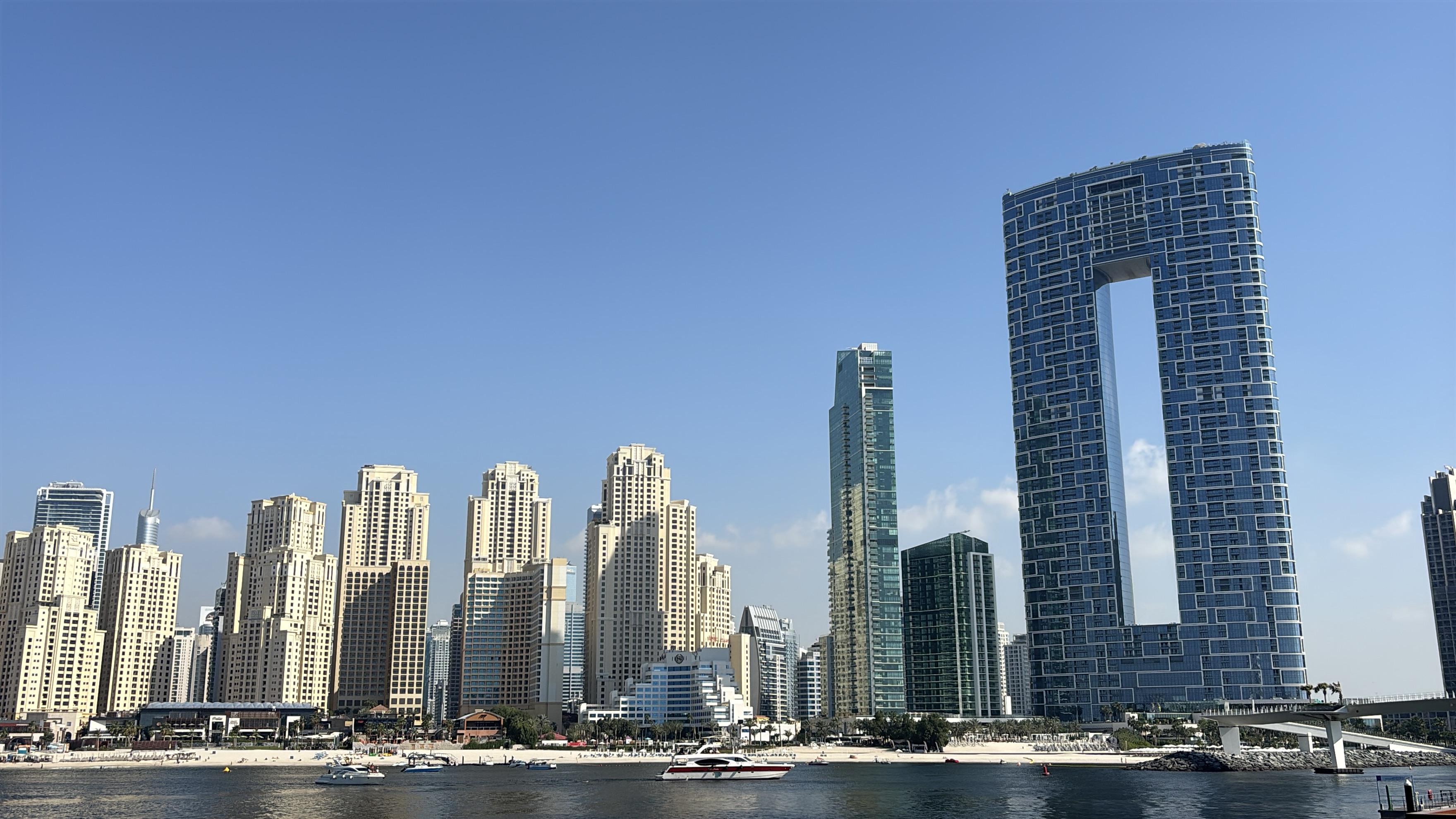
Look, if you've been glued to the news lately, you probably think the UAE property market is basically frozen solid. The escalation between the U.S., Israel, and Iran earlier this year rattled everyone. The Dubai Financial Market real estate index dropped over 15% in a single week. Felt like the whole city held its breath.
But here's what most people miss about Dubai. And Abu Dhabi, for that matter. Headlines almost never tell the full story. Not even close.
While speculative buyers definitely hit pause, the actual physical property market kept moving. The Dubai Land Department recorded 3,570 sales worth AED 11.93 billion during the first week of March - right in the thick of the chaos. The week after that, transaction value jumped 51% to AED 15.66 billion. Let that sink in for a second.
So what's really going on?
Money doesn't disappear during a crisis. It reorganizes. It shifts around in these somewhat predictable waves, and understanding that sequence is probably the most valuable thing any investor can do right now. Doesn't matter if you're a family office looking at a Palm Jumeirah villa or a pension fund eyeing logistics warehouses. You need to know when your wave is coming - and what to do before it arrives.
That's what this guide is about. Hard data, real timelines, and a specific plan for every type of investor.
How the 2026 Geopolitical Shock Actually Hit the Market
The Strait of Hormuz handles roughly 20% of the world's oil and gas. When that got disrupted, Brent crude blew past $110 a barrel in March. Aviation took a hit. Supply chains got messy. Fitch even warned about potential 15% price corrections if the conflict dragged on.
Reading that in isolation, you'd think the sky was falling. I get it.
But zoom out. The UAE walked into 2026 with some of the strongest economic fundamentals it's ever had. Dubai closed 2025 with over 215,000 property transactions totaling AED 682.6 billion - up 20% from the year before. Greenfield FDI surged 78% year-over-year, bringing in $98.4 billion across 5,000-plus projects between 2021 and 2025.
The geopolitical risk is real. Nobody's denying that. But the sheer volume of capital already committed to this region acts as a massive shock absorber.
Why Recovery Keeps Getting Faster
Want to know where the market is headed? Look at where it's been. The last three major crises show a striking pattern - each recovery was faster than the last.
Sources: Dubai Statistics Centre, DLD, IMF, Knight Frank.
The takeaway is clear. Crises create motivated sellers. They rarely destroy the underlying value of prime UAE real estate.
Three Recovery Scenarios for 2026–2027
Who Moves When: The Capital Flow Sequence
You can't perfectly time the market - anyone who says otherwise is selling something. But you absolutely can time your entry based on what kind of investor you are.
Now let me walk through what each group should actually be doing.
First wave. Fast money. High risk tolerance. These people aren't waiting for clarity - they're hunting for it.
This is your window if you run one of these. You're looking for sellers who need cash yesterday. Margin calls, restructuring, panic - whatever the reason, they're pricing for speed, not value.
On the Palm, that means genuine 20–35% discounts. Do the math on a AED 15 million villa. A 20% haircut is AED 3 million in instant equity. You simply cannot find that in a normal market.
- Keep cash ready to deploy without bank contingencies - lending slows during crises
- Talk to restructuring advisors and distressed debt brokers every single day - the best deals never make it to Property Finder
- Stick to completed freehold properties - off-plan carries too much execution risk right now
The biggest edge family offices have over institutional money? Speed. No committees. No six-month approval cycles. You can close on a trophy asset while the big funds are still drafting their risk memos.
And there's a reason 7,200 millionaires moved to the UAE in 2024 alone - making it the top destination globally for the third straight year. Palm Jumeirah apartments average AED 4,153 per square foot. Downtown Dubai sits at AED 2,980. Sounds expensive until you compare it to London or Hong Kong. The limited supply of ultra-luxury waterfront properties means demand will keep outpacing what's available.
- Know your parameters before you start shopping - yield play (5–7% net realistic in prime areas) or capital preservation?
- Structure your purchase to qualify for the Golden Visa - AED 2 million minimum gets you long-term residency alongside the asset
- If you're coming in from outside the dollar peg, hedge your currency - the AED-USD peg is great for stability but FX swings can quietly eat your returns
There's some overlap with the HNWI crowd here, obviously. But this group has one specific focus: buying premium homes outright, no leverage, for long-term holding or personal use. Legacy purchases, not flips.
Cash buyers basically control the top end of the Dubai market. Villa prices hit AED 2,277 per square foot in February 2026 - 91% higher than the 2020 average of AED 872. Even after that run-up, Dubai gives you more space per dollar than Singapore, London, or New York. And no income tax.
- Get your funds into a local UAE bank account now so you can move the moment a motivated seller surfaces
- Focus on scarcity - beachfront villas, Burj Khalifa-view penthouses, Emirates Hills - these are the assets that hold up best when markets get shaky
- Negotiate hard - a cash buyer who can close in days has enormous leverage over a seller who needs liquidity fast
Quick summary: Once the initial panic fades, private equity and corporate occupiers step in. They're after structured deals, developer recaps, and logistics space - before supply gets even tighter.
The second wave is more calculated. Less about speed, more about structure.
PE firms don't want simple buy-and-hold. They want complexity. Recapitalizations, mezzanine financing, special situations where they can roll up their sleeves and create value through active management.
Off-plan transactions made up 65% of Dubai's total deal volume in 2025 and 53% of market value. By March 2026, off-plan apartment sales alone hit $4.77 billion - up 12.9% year-over-year. That's a massive pool of opportunity for PE firms willing to provide developers with bridge capital or buy inventory in bulk at a discount.
- You need serious local structuring expertise - joint ventures, preferred equity, distressed debt are not straightforward in this jurisdiction without the right advisors
- Actual boots on the ground matter - operating partners, property managers, leasing agents. A value-add strategy doesn't work from behind a laptop in London
- Watch the data for sector rotation opportunities - early-cycle residential might be the entry point, but mid-cycle commercial and hospitality could offer better risk-adjusted returns as recovery broadens
This one's different from the rest because it's not really about investment returns. It's about operational necessity. Supply chain positioning. Warehousing. Corporate relocation. The Hormuz disruption made all of this feel a lot more urgent.
- Run a proper supply chain vulnerability assessment - figure out where your weak points are and which locations best mitigate geopolitical transit risk
- Get in front of industrial developers early - JAFZA, Dubai Industrial City are running out of quality space at 95% Grade A occupancy
- Lock in a 5-to-10-year lease while you still can - rents in this segment aren't coming down (Dubai Industrial City: +32% YoY to AED 58/sqft; Abu Dhabi: +22.4% to AED 470/sqm)
Quick summary: The slow-moving giants arrive last. Sovereign wealth funds, REITs, pension funds. They want stabilized, income-producing assets with transparent governance and predictable yields.
This is where the big, patient money comes in. And honestly, the current dislocation might be the best entry point institutional investors have seen in years.
Sovereign wealth funds and large asset managers usually wait six to eighteen months after a shock before deploying. They want to see stabilization. Predictable cash flows. Low drama.
But here's the opportunity they're looking at. Gross rental yields in Dubai range from 5.6% to 8.5% - that crushes what you'd get in most Western markets. Mid-market areas like JVC, where the average price is about AED 1,448 per square foot, tend to sit at the higher end of that yield range. And with investors from over 180 nationalities active in the market, rental demand is remarkably diversified. You're not dependent on any single buyer pool.
- Exploit the valuation gap - the temporary pause in mainstream capital means stabilized, income-producing assets at prices unavailable during the 2025 peak
- Pay close attention to replacement costs - construction delays mean existing institutional-grade buildings might be trading below what it would cost to build them from scratch
- Lean toward defensive sectors - logistics, industrial, and prime Abu Dhabi residential, where the sovereign ecosystem provides an extra layer of stability
REITs and pension money are typically last through the door. Nine to twenty-four months out. They need yield, transparency, stable macro conditions, and legal certainty. Regulatory constraints mean they can't take the same risks as a family office or PE fund.
But the template is already there. Emirates REIT posted a 20% jump in net property income for FY2025. Record sales of AED 80.4 billion - 16% above 2024. Total revenue up 40% to AED 49.6 billion. That's proof the REIT model works in the UAE when you've got quality assets underneath it.
- Focus on tenant quality - strong covenants, long weighted average lease terms (5+ years), and built-in rental escalations
- Ensure compliance with DFSA or ADGM frameworks and international tax reporting
- Diversify across sectors - commercial, education, healthcare, industrial - to avoid overexposure to any single segment
This one's tricky because it's entirely event-driven. Hospitality investors don't move until travel confidence comes back. And right now, that's still uncertain.
But the pre-conflict baseline was extraordinary. Dubai hotels averaged 80.7% occupancy in 2025, up from 78.2% the year before. Total occupied room nights hit 44.85 million. December 2025 broke records at 84.3%. Across the UAE, RevPAR was up over 14% and ADRs climbed more than 10%.
The Iran situation disrupted flights temporarily, but it didn't damage the underlying infrastructure or Dubai's appeal as a destination. For hospitality investors, the playbook is: watch the leading indicators obsessively - forward bookings, airport passenger counts, occupancy forecasts. Look for undercapitalized hotels or stalled developments you can pick up at a discount and reposition with a strong operator. And consider branded residences or serviced apartments as an alternative play. They give you more flexibility and better downside protection than pure short-stay hotel assets when tourism demand is bouncing around.
Five Signals Every Investor Should Be Watching
No matter what kind of investor you are, these are the indicators that will tell you where we are in the recovery.