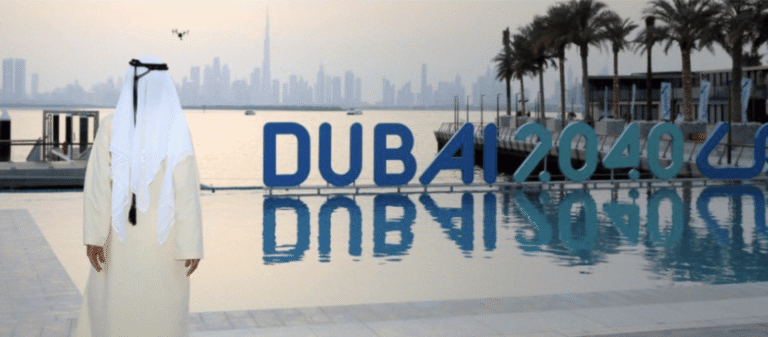


Most cities talk about blockchain. Dubai wrote it into how the government actually runs. The emirate launched its Blockchain Strategy in 2016 with a specific target: become the world’s first blockchain-powered government by 2021, with public documents paperless and stored on a distributed ledger. For property, that ambition matters, because real estate is where the transparency and speed of these systems either pay off or don’t.
The Dubai Future Foundation and Smart Dubai ran the strategy on three pillars: government efficiency, industry creation, and international leadership. The plan was not to dabble in the technology but to fold it into the fabric of how the city operates.
The objectives followed from that. Move government operations onto blockchain and cut out paper and administrative cost. Encourage new blockchain services across finance, healthcare, and real estate. And set a precedent in governance and usage that shapes how other places do it, positioning Dubai as an early mover rather than a follower.
Blockchain in Dubai’s Property Market
The clearest application in Dubai’s real estate is the smart contract. These are agreements with the terms written directly into code, and they execute themselves once conditions are met. That takes a lot of the manual steps, and some of the intermediaries like brokers and lawyers, out of the process, which cuts both time and cost.
In an industry where transactions are usually intricate and slow, self-executing agreements add efficiency and a layer of trust. Nothing fires until the conditions are satisfied, so there is less room for a step to be skipped or disputed.
Digitising property records does the second half of the job. Storing records in a tamper-proof ledger that the relevant parties can see in real time cuts the risk of forgery, loss, and mismanagement. It secures the record and makes transactions faster and more reliable, which pushes the whole market toward being more integrated and transparent.
The efficiency gains are the headline. Automation through smart contracts plus secure record storage has compressed what used to take weeks or months into a few days. That helps buyers and sellers directly and makes the market more competitive. And cutting intermediaries cuts cost, which makes Dubai property more attractive to both domestic and international investors. Lower costs and faster processing widen the market’s appeal.
Transparency and Security
Fraud is the property industry’s oldest problem worldwide, and this is where blockchain earns its place. It creates a secure, unchangeable record of every transaction, time-stamped and linked into a chain, which makes double-selling a property or falsifying documents extremely hard to pull off.
Transparency is the flip side of the same feature. With transactions on a shared ledger, buyers, sellers, and investors can verify details whenever they want, which builds trust across the table. In Dubai, where foreign investment in property runs high, that matters. Blockchain gives international investors a single reliable source of truth on ownership and property details, and it makes verification far simpler from abroad.
Security and transparency feed confidence directly. Investors who trust that a deal is secure and visible are more willing to commit, and that is central to Dubai’s pitch as a safe, modern market.
The technology also widens access. Cross-border transactions become simpler and safer, so investors elsewhere can participate without the usual friction of currency exchange, time delays, or being physically present.
Tokenisation is the piece with the biggest long-term potential. Splitting a property into smaller units, or tokens, that trade on a blockchain platform lets investors buy and sell fractions rather than whole assets. That improves liquidity and opens the market to people who could never buy an entire property outright. Add the option to transact in cryptocurrency, and Dubai gets another draw for tech-minded investors and anyone looking to diversify.
Challenges and What Comes Next
The benefits are real, but so are the obstacles. The biggest is standardisation. A system only works when everyone uses the same one, and while Dubai is out in front, integrating with the global property market will need broad agreement on standards that does not exist yet.
Regulation is the other constraint. Dubai set up the Virtual Assets Regulatory Authority (VARA) to oversee digital assets, which is a genuine step, but the rules still have to evolve to handle the complexity of blockchain transactions and mesh cleanly with existing legal frameworks.
Looking forward, the direction is promising. As the technology matures, expect more applications, and expect advances in AI and machine learning to layer on top, pushing the efficiency and security of blockchain-based transactions further.
Where This Leaves Dubai
The strategy is a serious bet on reshaping how property changes hands. By building blockchain into transactions, Dubai is improving transparency, security, and speed, and making the market more appealing to investors while cementing its position as an early leader in adoption. The challenges around standards and regulation are real and not yet solved, but the trajectory points to a property market that is more secure, faster, and easier to access from anywhere, and a set of lessons other cities will end up borrowing.
Additional Resources
How to Invest in Dubai Real Estate Using Cryptocurrency: A Comprehensive Guide
Top Free Zones in Dubai for Entrepreneurs: A Comprehensive Guide