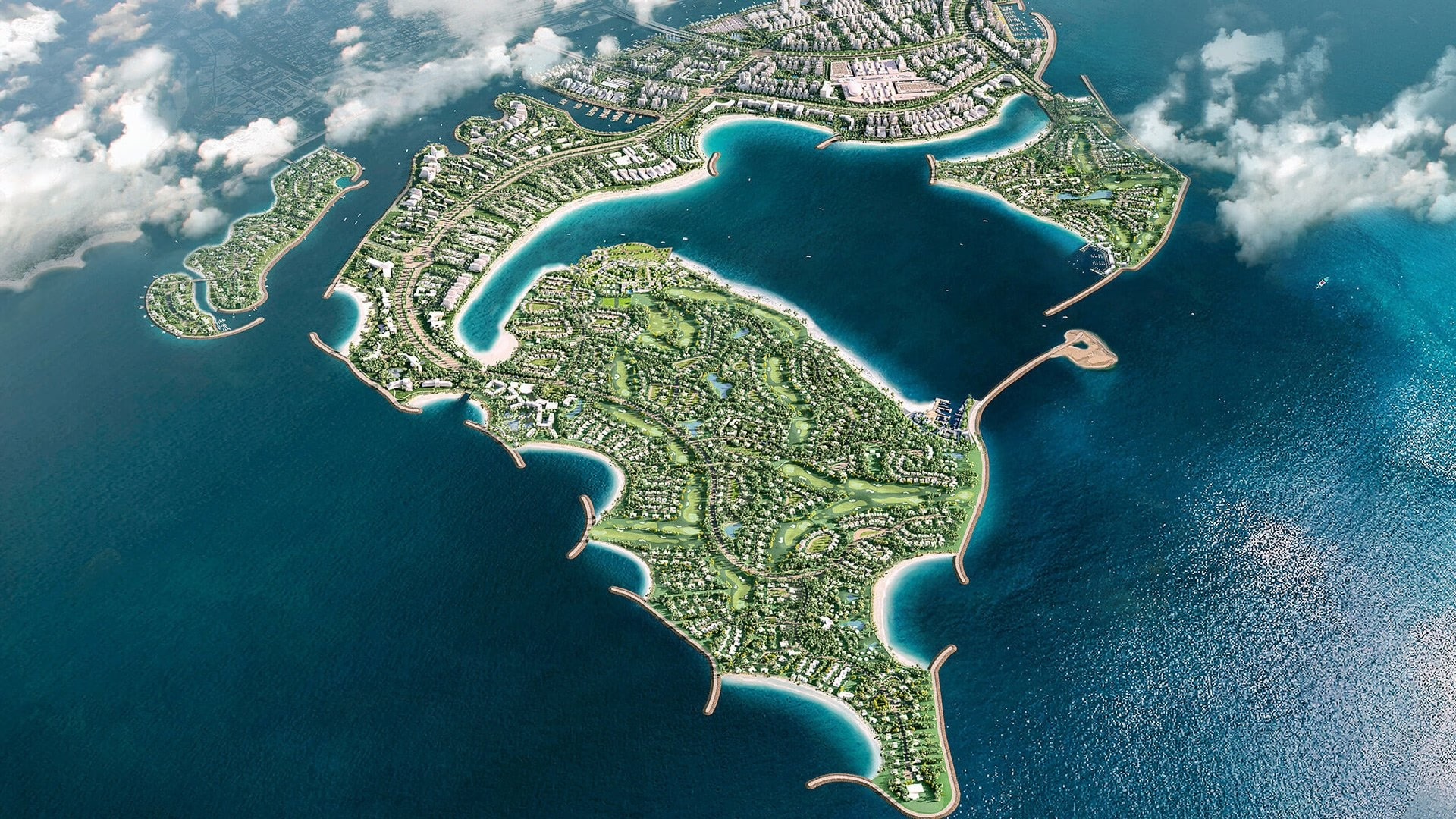
Dubai Islands (formerly Deira Islands)
Dubai Islands is a major five-island waterfront master development by Nakheel, covering about 17 square kilometers just off the Deira coastline. It is one of the city’s last big coastal expansions in this part of Dubai, designed to blend beach, resort, and residential living, without feeling as “loud” as some of the older, high-density waterfront hotspots. Think 20+ kilometers of beaches, a Blue Flag certified beach, marinas and promenades, big parkland, and “premium golf courses” planned right on the water.
Dubai Islands is trying to be a calmer, more spacious version of waterfront Dubai that still sits close to the airport and Old Dubai, with a price positioning that often looks more approachable than Palm Jumeirah, at least in many entry points. That is the thesis. The reality will depend on which pocket you buy in, your view corridor, and how quickly the district’s hotel, retail, and beach infrastructure matures.
What Dubai Islands actually is (and what it is not)
Dubai has a few “waterfront stories” running at the same time. Some are already fully priced-in and mature, like Dubai Marina. Some are prestige-led, like Palm Jumeirah. Dubai Islands is a different angle.
It is a five-island district planned as an interconnected coastal destination, with the scale to hold a big hospitality backbone (80+ resorts and hotels is not a casual number), plus residential communities, retail, cultural hubs, and outdoor recreation.
It is also explicitly tied to the Dubai 2040 Urban Master Plan direction, which usually means: more walkability, more open space, healthier communities, better connectivity, and districts that feel “complete” rather than just a cluster of towers. That is the intent, anyway.
What it is not (at least in its positioning): it is not trying to be a wall of supertalls. The master narrative leans toward beaches, parks, promenade life, and a lower-to-mid-rise residential feel in many components, with resorts doing a lot of the destination work early on.
Dubai Islands quick facts
| Item | Details |
|---|---|
| Masterplan Developer | Nakheel |
| Size | Approximately 17 square km across five islands |
| Beaches | 20+ km including Blue Flag certified beach |
| Hotels | 80+ resorts and hotels planned |
| Parks | Over 2 square km parks and open spaces |
| Structure | Interconnected islands with promenades and pathways |
Location and access, this is the part investors sometimes underestimate
Dubai Islands sits off the coast of Deira, which makes it feel deceptively central in a Dubai kind of way. You are close to historic Dubai, closer to DXB than most of the newer coastal districts, and still within workable distance to Downtown, DIFC, and the core business zones, depending on time of day.
A lot of guides quote 15 to 20 minutes to Dubai International Airport, and often similar estimates to Downtown, but you should treat that as “good traffic” timing, not a promise. Still, the proximity is real, and it is one of the location advantages that is hard to replicate for brand-new waterfront districts.
The five islands, and what each one is aiming to be
Nakheel frames Dubai Islands as five distinct isles, each with its own identity. The names you will see used include: The Central Island, Marina Island, Shore Island, Golf Island, and Elite Island.
Now, a small but important point: masterplans evolve. Names stay, land use gets refined, “where the action is” can shift based on which projects launch first and which hospitality anchors open on schedule. So it helps to think of the islands less as rigid borders, and more as five themed zones that should gradually stitch together.
A practical interpretation of the island themes
The “everyday” amenities that actually matter
A lot of projects talk about luxury, but tenants and end-users usually care about repeatable basics:
- Beach access that feels usable, not a tiny strip that becomes a crowded photo spot.
- Promenades and pathways, because walkability is not a nice-to-have anymore, it is a rental driver in practice.
- Parks and open space for families, pet owners, and long-stay tenants.
- Retail and casual F&B that opens early and stays late.
Dubai Islands is designed around those fundamentals, at least on paper, with the scale to support them.
Dubai Islands Beach, and why the pet-friendly angle is not just “cute”
Dubai Islands Beach is positioned as the city’s first fully pet-friendly beach. Now, is that going to matter to every buyer? No. But it matters a lot to a specific tenant segment, especially expats who treat their dog like family and will choose a neighbourhood based on whether they can walk, jog, and relax with their pet without drama. Those tenants often pay reliably, stay longer, and take care of units, not always, but often enough that it is worth noting.
What is live today vs what is planned
This is where investors sometimes get a bit too optimistic, or the opposite, too skeptical. Dubai Islands is not “finished”, but it is not a blank map either. There are already destination pieces and active development momentum.
Buyer profiles, who Dubai Islands is best for
This is the part I would actually use in a sales consultation, because it reduces wasted viewings.
1) The “yield-first but not ultra-prime” investor
They want waterfront, they want a story tenants understand, but they do not want Palm-level entry pricing or the same service charge burden you can get in ultra-luxury towers. Dubai Islands often fits that middle lane, luxury-adjacent, but with more runway for value discovery if the district executes the hospitality and retail plan.
2) The holiday-home operator who wants a cleaner operating story
If you are running short-term lets, beach proximity and “destination pull” matter. You still need to follow compliance. Apartments and villas must be registered and approved before listing as holiday homes, and you apply for permits through the DET system. Dubai Islands can work well here because it is built to attract visitors, not just residents, but you must underwrite for seasonality and operational load.
3) The family buyer who wants space, parks, and a calmer waterfront
Nakheel’s positioning leans into wellbeing, parks, and lifestyle infrastructure, not only skyline glamour. Families care about layouts, parking, traffic flow, and daily convenience. Dubai Islands can outperform more hectic waterfront zones if parks, retail, and community services mature practically.
4) The “DXB proximity” buyer
If someone flies constantly, being nearer to DXB while still having a beach lifestyle can feel like a big advantage. Dubai Islands, sitting off Deira, plays well into that logic.
Micro tips for picking the right unit in Dubai Islands
This is where people either make a smart buy, or they buy the wrong stack and spend years defending it.
- Prioritize clean water views or park-facing views, not “partial sea” blocked by future plots.
- Check road adjacency, some waterfront districts hide service roads and back-of-house lanes in ways that kill balcony enjoyment.
- Think about wind and sun, sunset views sell, but direct afternoon sun can make units harder to live in unless glazing and shading are good.
- Ask what will be built in front of you, not just “what exists today”. In masterplans, emptiness is often future density waiting its turn.
Dubai Islands Investment Research & Guides.
Available in Dubai Islands
Currently tracking 91 off-plan properties (Apartment, Apartment, Beach Properties, Apartments, Apartments, Beach Properties, Apartments, Branded Residences, Beach Properties, Villas) in Dubai Islands, Dubai priced from AED 1.3M – AED 14M. View the full list.
Lifestyle
- Resort waterfront
- Beach district vibe
- Calm, low density feel
- Family friendly living
- Walkable promenades
- Tourism led upside
Property Types
- Waterfront apartments
- Duplexes
- Penthouses
- Townhouses
- Villas
- Branded residences
Amenities
- 20 km beaches
- Blue Flag beach
- Parks
- Green space
- Marina lifestyle
- Waterfront dining
- Retail promenades
- Souk Al Marfa
- Resorts
- Hotels
Connectivity
- Deira coastline
- Old Dubai access
- Mainland bridges
- Sea transport access
- DXB proximity
- Downtown reach
- DIFC access