
Ask an international buyer why they keep coming back to Dubai and the honest answer is rarely one headline number. It is the stack: a location that sits between three continents, an economy that stopped leaning on oil, rules that a foreign owner can actually read, and infrastructure that keeps a tenant in the building. Any one of those on its own is not decisive. Together they are why the emirate keeps pulling capital that could go anywhere.
Location and connectivity do real work
Dubai sits between Europe, Asia, and Africa, and it has built the airports, seaports, and roads to make that geography count rather than just look good on a map. For an investor, connectivity is not an abstraction. It decides how easily tenants arrive, how fast businesses set up, and how deep your rental demand runs.
Dubai International Airport (DXB)
DXB handles over 88 million passengers a year and ranks third worldwide for international passenger traffic. That level of traffic feeds both tourism and business relocation, which is exactly the demand base a residential or commercial landlord wants underneath a lease.

On visitors, the Dubai Department of Tourism and Commerce Marketing (DTCM) recorded around 16.7 million international visitors in the first half of 2022 alone. That is a serious flow of people passing through, and a lot of them come back to buy.
Ports and trade
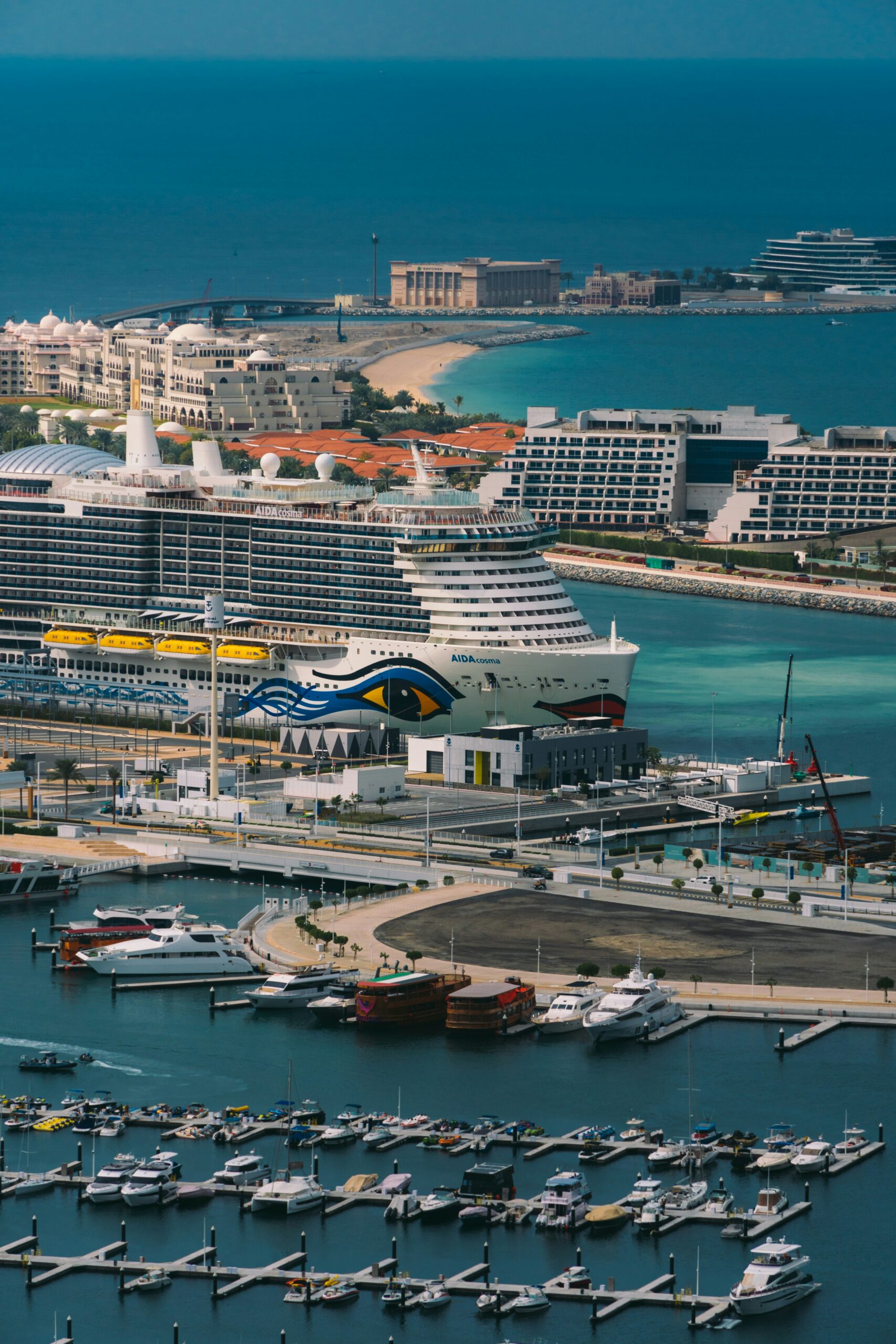
Jebel Ali Port is the largest port in the Middle East and handles roughly 80% of Dubai’s container traffic. That makes it the anchor for logistics, supply-chain operations, and industrial real estate in the emirate.

According to the Dubai Ports Authority, Jebel Ali moved over 14.3 million TEUs (Twenty-Foot Equivalent Units) of cargo in 2021. Numbers like that are why industrial and warehouse assets near the port hold their tenants.
A more stable economy, on purpose
The reason the market feels less fragile than it did a decade ago is that the government deliberately moved the economy off oil. The push into tourism, trade, finance, technology, and real estate was policy, not accident.
Non-oil GDP
Dubai Department of Economic Development (DED) figures show non-oil sectors lifting their share of GDP from 70% in 2019 to 73% in 2021. That shift matters to a property investor because it means your asset is sitting on a broader base of demand, not a single commodity price.
Real estate is still a large part of that economy, but now it is supported by tourism, retail, logistics, and tech rather than propping things up alone.
Vision 2030 and the economic plan
Dubai’s Vision 2030, launched in 2016, set out to make the city a global base for business, tourism, and logistics, with foreign investment and innovation at the centre. Alongside it, the Dubai Economic Plan 2025, the Dubai Industrial Strategy, and the Dubai Innovation Strategy are aimed at growing industrial and knowledge sectors, which feeds directly into commercial real estate demand.
Dubai FDI has stated a target of AED 100 billion (about $27.2 billion) in foreign direct investment by 2030. Whether or not the emirate hits that exact figure, the direction of travel is what an investor is buying into.
Rules a foreign owner can actually read
The part that surprises people who have bought elsewhere is how legible the process is. The Dubai Land Department (DLD) runs registration and dispute handling in a way that keeps transactions clean.
Freehold ownership
Foreign investors can own property outright in designated freehold zones. Since freehold was introduced in 2002, non-nationals have been able to buy in over 30 prime areas, including Downtown Dubai, Dubai Marina, and Palm Jumeirah.

The Dubai Land Department reports that as of 2021 almost 49% of Dubai’s land is freehold, which is a lot of open ground for international buyers.
Escrow and investor protection
The DLD’s legal framework leans hard on escrow accounts, so developers hold buyer funds in trust until the project is delivered. That single mechanism is what protects you on off-plan more than any marketing promise. In 2021 the DLD reported that around 95% of real estate deals used escrow accounts.
Infrastructure that keeps tenants in the building
The transport and utilities spend is not just civic pride. A metro stop, a tram line, or an easier commute is what keeps a unit leased and lets you raise the rent at renewal.
Transport spend
The Roads and Transport Authority (RTA) reported that Dubai’s public transport system carried over 405 million passengers in 2021. Projects like the Dubai Metro, the Dubai Tram, and highway expansions are the reason certain communities let faster than others.
Master-planned communities
Communities such as Dubai Marina, Downtown Dubai, and Dubai Hills Estate mix residential, commercial, and leisure space in one place, which is what makes them self-sufficient enough to hold value.

The Dubai Land Department recorded AED 11 billion in commercial real estate transactions in mixed-use developments in 2021, which tells you where the demand is concentrating.
What the returns actually look like
Yields in Dubai have held up better than a lot of markets people consider safer, and the reason is the diversified demand underneath them.
Rental yields
A 2021 CBRE report put office yields at an average of 6% to 8%, and industrial and logistics space at 7% to 9%. Both are strong relative to the region.

Retail in prime locations such as Dubai Mall and The Walk at JBR came in at 5% to 7%, carried by foot traffic and tourism.
Holding up under pressure
The market has taken hits and recovered. COVID-19 dented transactions for a period, but it also pushed demand toward flexible office space and remote-friendly living, which kept investors engaged. In 2021 Dubai saw a 3.5% increase in commercial real estate transactions on the prior year, which is the recovery showing up in the data.
Who is actually buying
The buyer base is not just individual expats. Sovereign wealth funds and institutions moved in because the economy is stable and the rules are clear. A 2021 Dubai FDI report noted foreign direct investment in Dubai’s real estate sector rose 26% in 2020, with a large share coming from GCC countries, Europe, and Asia. The same report projects FDI into commercial real estate continuing toward that AED 100 billion (about $27.2 billion) mark by 2030.
The point for a buyer
None of these factors wins on its own. The case for Dubai is that location, a diversified economy, readable rules, and real infrastructure line up at the same time, and that combination is hard to find in one jurisdiction. If you want the next step, and the practical side of having an asset here run for you while you sit abroad, read How to Choose a Reliable Dubai Property Manager: An Overseas Owner’s Guide, or contact a Totality Estates Dubai specialist.