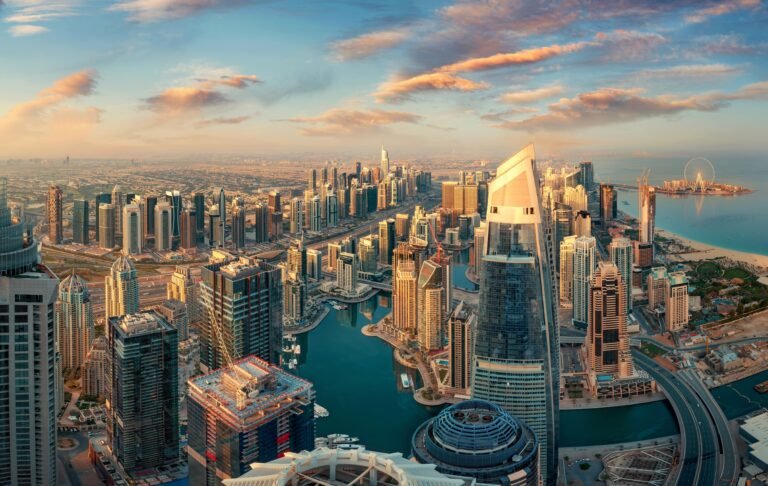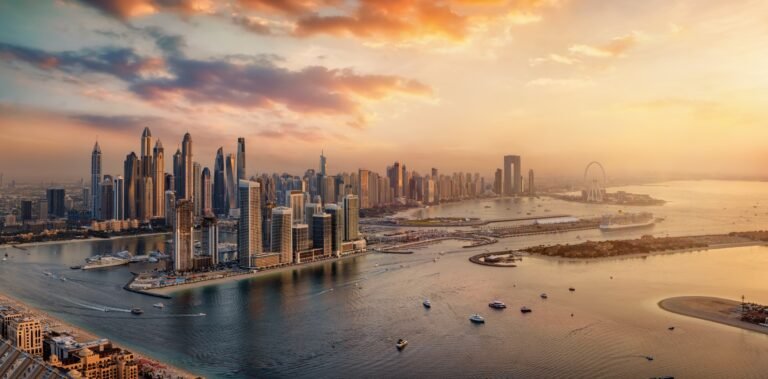

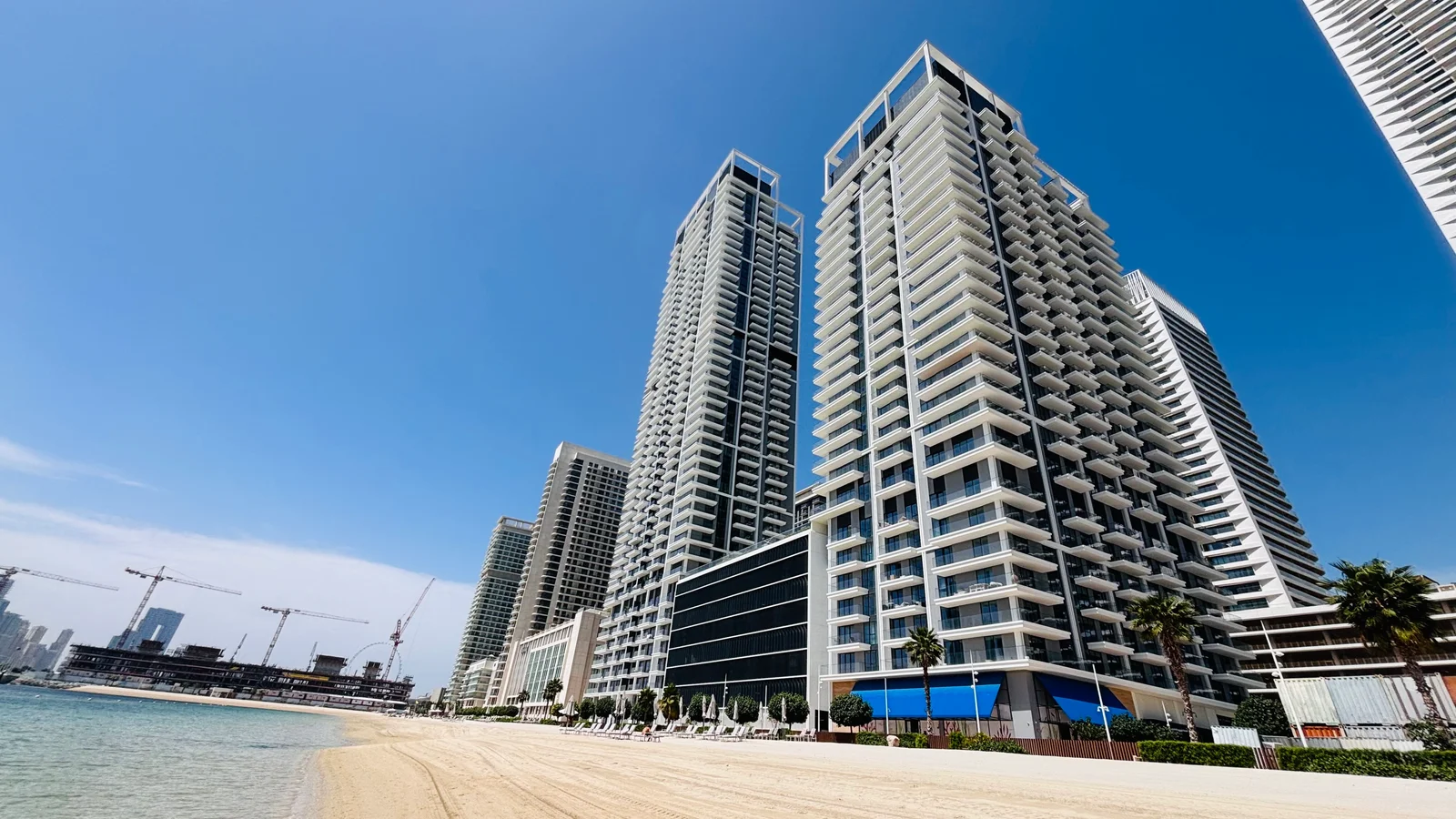
Waterfront apartments in Dubai represent one of the most liquid and capital-appreciating segments of the UAE property market in 2026. Key districts include Dubai Marina, Emaar Beachfront, Dubai Creek Harbour, Bluewaters Island, and the emerging Dubai Islands. Entry prices range from approximately AED 600,000 for compact units in newer developments to well above AED 10 million for premium waterfront penthouses. Foreign nationals can own freehold in designated zones, with no annual property tax and strong gross rental yields typically in the 5–8% range depending on location and unit type.
Key Takeaways
| Waterfront supply is finite. Dubai’s coastline and canal-front land is limited by geography and planning, which structurally supports long-term price appreciation. | |
| Multiple submarkets exist at different price points: Dubai Marina and Palm Jumeirah sit at the premium end; Azizi Venice and Dubai Islands offer more accessible entry prices. | |
| Rental yields are competitive globally. Waterfront units in Dubai routinely outperform equivalent assets in London, Singapore, or Sydney on a gross yield basis, partly because there is no annual property tax. | |
| Off-plan waterfront projects offer staged payment plans and developer incentives, but carry completion risk that buyers should assess carefully. | |
| The UAE Golden Visa is accessible to property investors meeting the AED 2 million threshold, adding a residency dimension to the investment case. | |
| Emaar Beachfront and Dubai Creek Harbour are the two largest master-planned waterfront additions delivering units through 2026. | |
| Short-term rental licensing is available through the Dubai Department of Economy and Tourism, making holiday-let strategies viable for waterfront units in tourist-heavy zones. | |
| Due diligence on the developer matters enormously in off-plan purchases. Escrow account compliance and RERA registration are non-negotiable checkpoints. | |
| Currency exposure is minimal for USD-based investors because the AED is pegged to the US dollar at a fixed rate. |
What Makes Waterfront Apartments in Dubai a Distinct Asset Class?
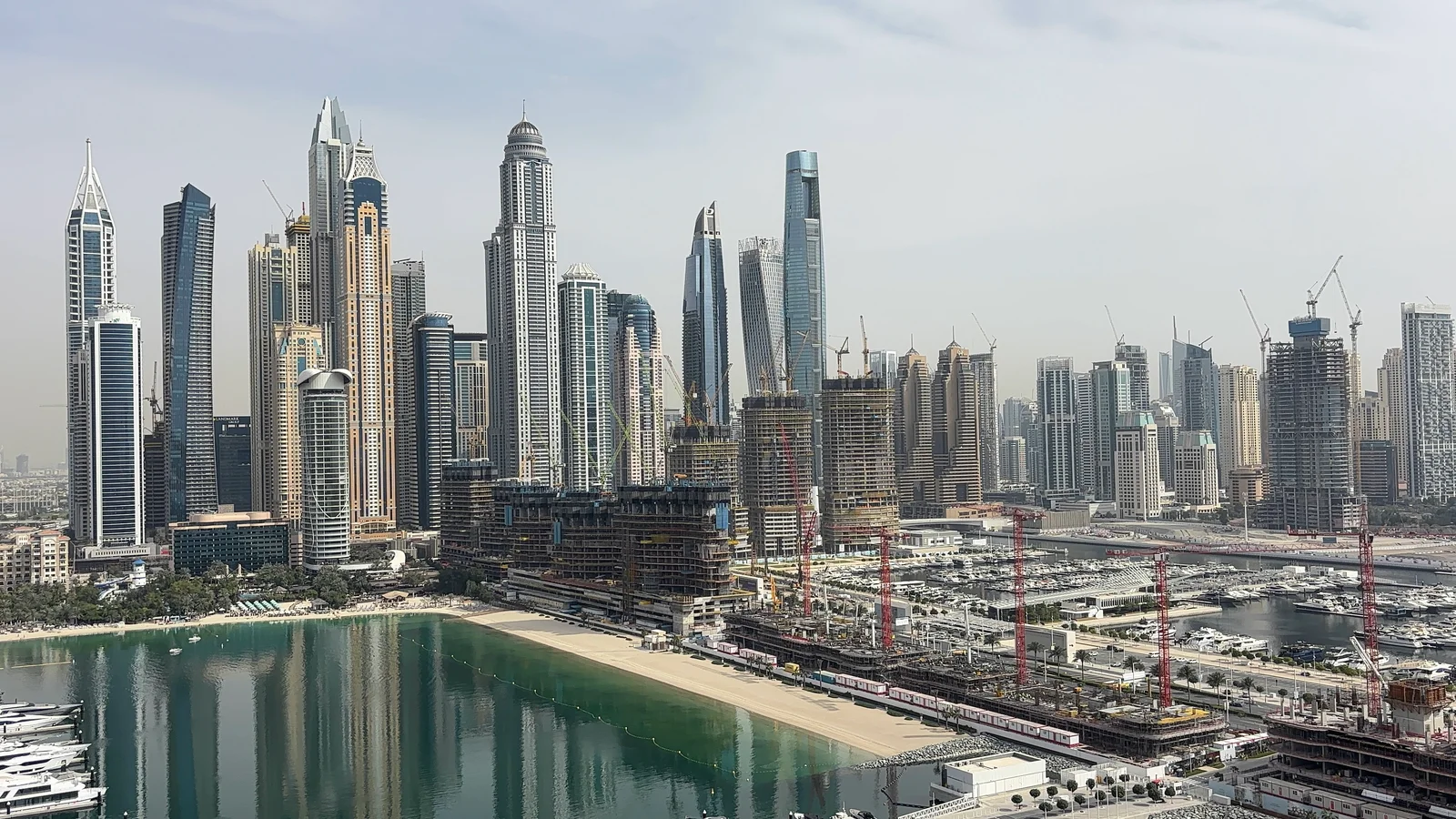
Waterfront apartments in Dubai are not simply “apartments with a view.” They occupy a structurally different position in the market because the supply of genuine waterfront land is constrained, demand is driven by both end-users and investors from over 200 nationalities, and the regulatory environment actively protects buyer funds through escrow legislation.
The distinction matters for portfolio construction. A waterfront unit in Dubai Marina or on Emaar Beachfront tends to hold value through market corrections better than an equivalent inland unit, partly because of lifestyle scarcity and partly because these zones attract a globally mobile tenant base willing to pay a premium for proximity to water.
For family offices and wealth managers evaluating real estate allocations, this scarcity premium is worth quantifying. It is also worth noting that “waterfront” in Dubai covers several distinct typologies: marina-front, sea-facing, creek-front, lagoon-adjacent, and canal-side. Each carries different risk and yield characteristics, which the sections below address in detail.
Which Waterfront Districts Should Investors Prioritize in 2026?
The right district depends on investment horizon, target tenant profile, and budget. There is no single best answer, but there are clear trade-offs.
Dubai Marina
Dubai Marina remains the benchmark waterfront address for rental investors. The district features high-rise towers with direct marina views, the Marina Walk promenade, yacht club access, and dense F&B and retail infrastructure. Smart building technology, green rooftops, and water reclamation systems are increasingly standard in newer towers here, which matters for ESG-conscious institutional buyers.
Choose Dubai Marina if: you want high liquidity, a proven short-term rental market, and an established tenant base of finance and tech professionals.
Emaar’s Marina Shores project within this district offers waterfront apartments and townhouses with marina views and proximity to yacht clubs, representing one of the more credible off-plan options currently available.
Emaar Beachfront
Positioned on a private island between Dubai Marina and Palm Jumeirah, Emaar Beachfront is arguably the most carefully planned new waterfront community in Dubai. Towers including Beachgate and Bayview are delivering units through 2026, featuring private beach access, Arabian Gulf views, and gated-community security. The developer’s track record here is strong, and the location benefits from proximity to both the Marina metro corridor and Sheikh Zayed Road.
This is a community that appeals strongly to end-users, which tends to support resale values over time.
Dubai Creek Harbour
Dubai Creek Harbour is Emaar’s most ambitious project, designed as a “second Downtown Dubai” with creek and marina views. Apartments are launching from approximately AED 1.5 million, with expected handovers around 2026 for several towers. The district includes a planned retail and hospitality spine, and the creek-front positioning gives it a different visual character from the Gulf-facing communities.
For investors with a 3–5 year horizon, Creek Harbour offers the combination of a credible developer, an emerging district premium, and infrastructure that is visibly materializing.
Bluewaters Island
Bluewaters is a smaller, more exclusive enclave anchored by Ain Dubai and featuring contemporary residences with expansive layouts and Arabian Gulf views. It functions as both a tourism destination and a residential address, which creates a dual-income dynamic for short-term rental operators. Supply is tightly controlled, which has historically supported price stability.
Dubai Islands
Dubai Islands represents one of the few major new waterfront districts with meaningful remaining supply. Projects like Flora Shore Beachfront Residences by Calgary Properties offer 1–4 bedroom apartments with full sea-facing units, private beach access, rooftop pools, and marina views. The district is in an earlier phase of development, which means buyers accept more location risk in exchange for potentially stronger capital appreciation as infrastructure matures.
For investors comfortable with a longer horizon, Dubai Islands is worth serious attention. For those needing immediate rental income, it is perhaps not the first choice right now.
Azizi Venice
Azizi Venice is positioned differently from the above. Located near Al Maktoum International Airport with Dubai Metro connectivity, it offers studios to 4-bedroom residences starting from AED 600,000, with crystal lagoons, water canals, and the UAE’s first Opera House within the community. The price point makes it accessible to a wider investor base, and the airport proximity will become increasingly relevant as Al Maktoum expands.
Treating Azizi Venice as directly comparable to Emaar Beachfront on a per-square-foot basis. The water here is lagoon and canal, not the Arabian Gulf, and the tenant profile will differ accordingly.
You can explore the full range of off-plan beach properties for sale in Dubai to compare current listings across these districts.
What Are the Realistic Costs of Buying Waterfront Apartments in Dubai?
Understanding the total acquisition cost is essential before committing capital. The headline price is rarely the full story.
| Cost Component | Typical Amount |
|---|---|
| Dubai Land Department (DLD) Transfer Fee | 4% of purchase price |
| DLD Trustee / Admin Fee | AED 4,000–5,000 (approx.) |
| Real Estate Agent Commission | Resale only — 2% + 5% VAT |
| Mortgage Registration Fee (if financed) | 0.25% of loan amount |
| Conveyancing / Legal Fees | AED 6,000–15,000 (varies) |
| Service Charges (annual, ongoing) | AED 12–30+ per sq ft depending on community |
The 2% + VAT agency commission applies to resale transactions only. When buying directly from a developer on a new launch or off-plan project, the buyer pays no broker commission — the developer covers the agent’s fee. This can reduce upfront costs meaningfully on off-plan waterfront purchases.
So on a AED 3 million waterfront apartment, a cash buyer should budget roughly AED 3.18–3.25 million all-in before furnishing or fit-out. Some developers offer DLD fee waivers as promotional incentives on off-plan purchases, which can meaningfully reduce the entry cost. It is worth checking whether any active waiver applies before signing a sales agreement.
There is no annual property tax in Dubai, which is a significant structural advantage compared to most OECD markets. Service charges are the primary recurring cost, and in premium waterfront communities these can be substantial, so buyers should request the RERA-approved service charge schedule before committing.
For a detailed breakdown of all fees, the Dubai Property FAQs section covers transfer fees, mortgage costs, and DLD charges in plain language.
What Rental Yields Can Investors Expect from Waterfront Apartments in Dubai?
Gross rental yields on waterfront apartments in Dubai typically range from 5% to 8% annually, with meaningful variation by district, unit size, and rental strategy. These figures are estimates based on market observation and should be stress-tested against current comparable listings before making investment decisions.
|
Gross Yield Floor
5%
Long-term leased premium units
|
Upper End Range
8%
Smaller units, active short-term rentals
|
A few patterns are worth noting:
| Smaller units (studios and 1-bedrooms) tend to generate higher gross yields than larger units because the per-square-foot rental rate is higher, even though the absolute rent is lower. | |
| Short-term rental strategies can push effective yields above 8% in high-demand waterfront zones like Dubai Marina and Bluewaters, but they require active management, licensing from the Dubai Department of Economy and Tourism, and tolerance for occupancy variability. | |
| Long-term furnished leases to corporate tenants are common in Emaar Beachfront and Creek Harbour, offering more predictable income with lower management intensity. | |
| Off-plan purchases generate no rental income during the construction period, so the effective yield calculation must account for the carry period. |
The rental yield data for Dubai provides a useful baseline for district-by-district comparisons before finalizing any investment thesis.
One thing that is easy to overlook: service charges reduce net yield materially in premium waterfront buildings. A gross yield of 7% can become a net yield of 4.5–5% once service charges, agency management fees, and occasional vacancy are factored in. That is still competitive globally, but the numbers should be modeled honestly.
How Does the Off-Plan Waterfront Market Work in Dubai?
Off-plan waterfront apartments in Dubai are sold directly by developers before construction completes, typically with staged payment plans that spread capital outlay over the construction period. This structure has become the dominant buying channel in the Dubai market, and it is particularly prevalent in new waterfront districts like Dubai Islands, Creek Harbour, and Emaar Beachfront.
The basic process:
|
1
|
Reserve the unit with a booking deposit, usually 5–10% of the purchase price. |
|
2
|
Sign the Sales and Purchase Agreement (SPA) within a defined window, typically 30 days. |
|
3
|
Pay installments according to the developer’s construction-linked or time-linked schedule. |
|
4
|
Register the off-plan transaction with the Dubai Land Department (this is mandatory and protects the buyer’s title). |
|
5
|
Receive handover and complete final payment, usually 30–40% of the total price. |
The key protection for buyers is that developer payments must be held in a RERA-regulated escrow account and can only be released against verified construction milestones. This significantly reduces the risk of developer insolvency compared to unregulated markets.
Some developers offer post-handover payment plans where a portion of the price is paid over 2–3 years after receiving the keys. These can be attractive for cash flow management, but they typically come with a price premium baked into the unit cost. Compare the effective total cost against a standard payment plan before deciding.
For investors newer to this market, the off-plan apartments for sale in Dubai section provides a current inventory of registered projects with payment plan details.
Is the UAE Golden Visa Accessible Through Waterfront Property Investment?
Yes, and this is a meaningful part of the investment case for many buyers. The UAE Golden Visa grants a 10-year renewable residency to property investors who meet the AED 2 million minimum property value threshold. Crucially, the property can be mortgaged, provided the equity already paid to the developer or bank meets the AED 2 million threshold.
For waterfront apartments in Dubai, many units in Dubai Marina, Emaar Beachfront, and Creek Harbour naturally exceed the AED 2 million mark, making Golden Visa eligibility almost automatic for buyers in those districts.
The residency benefits are substantial for internationally mobile investors: UAE residency enables local bank account opening, driving licenses, school enrollment for dependents, and access to the UAE’s healthcare system. For family offices managing multi-generational wealth, the ability to establish a UAE base of operations through a property investment is a genuine structural advantage.
You can check eligibility quickly using the UAE Golden Visa eligibility calculator to see whether a specific purchase qualifies.
What Are the Risks Specific to Waterfront Apartments in Dubai?
Every asset class carries risk, and waterfront apartments in Dubai are no exception. The risks here are specific and manageable, but they deserve honest treatment.
Construction and delivery risk is the most common concern with off-plan purchases. Dubai has a history of project delays, though the regulatory environment has improved significantly since the 2008 cycle. Choosing a developer with a completed project track record in Dubai, not just announced projects, is the most effective mitigation.
Oversupply in specific micro-markets is a real possibility. Dubai’s development pipeline is large, and certain building typologies (particularly mid-range 1-bedroom units in newer districts) may face rental competition as multiple towers deliver simultaneously. Waterfront scarcity helps, but it does not fully insulate against this dynamic.
Liquidity risk is lower than in many markets because Dubai has an active secondary market and relatively low transaction costs compared to European markets, but it is not zero. In a market downturn, waterfront units at the premium end can sit unsold for longer than mid-market units simply because the buyer pool is smaller.
Currency risk is effectively eliminated for USD-based investors given the AED/USD peg, but investors holding EUR, GBP, or other currencies carry exchange rate exposure.
Regulatory risk is low but worth monitoring. Dubai’s property laws have been consistently investor-friendly, but policy changes around short-term rental licensing, foreign ownership zones, or service charge regulation could affect returns.
For a broader view of current market conditions and how these risks are playing out in practice, the Dubai property market report for March 2026 provides a useful current-state assessment.
How Do Waterfront Apartments in Dubai Compare to Other Global Waterfront Markets?
This comparison is relevant for institutional investors and family offices benchmarking Dubai against alternative allocations.
| Market | Gross Yield | Annual Property Tax | Foreign Ownership | FX Risk vs USD |
|---|---|---|---|---|
| Dubai (waterfront) | 5–8% | None | Freehold in designated zones | None (pegged) |
| London (Thames-front) | 2.5–4% | Council tax + stamp duty | Permitted | GBP exposure |
| Singapore (Marina Bay) | 2–3.5% | ABSD up to 60% | Restricted | SGD exposure |
| Miami (Brickell/Biscayne) | 3.5–5.5% | ~1–2% annually | Permitted | None |
| Sydney (Harbour-front) | 2–3.5% | Land tax applicable | FIRB restrictions | AUD exposure |
The yield differential is significant. Dubai’s combination of no annual property tax, freehold foreign ownership, and a USD-pegged currency creates a structural advantage that is difficult to replicate in most comparable markets. The trade-off is that Dubai is a younger market with a shorter price history and a regulatory environment that, while improving, is less tested through multiple full cycles than London or New York.
For investors who have already read through the complete guide to investing in Dubai property for foreigners, this comparison table adds a useful quantitative layer to the qualitative case.
What Should Investors Check Before Buying Waterfront Apartments in Dubai?
Due diligence on waterfront purchases in Dubai follows a clear sequence. Skipping steps here is where most avoidable problems originate.
Pre-purchase checklist:
| Confirm the project is registered with RERA and the developer holds a valid escrow account | |
| Verify the developer’s track record: how many projects have they delivered on time in Dubai specifically? | |
| Review the Title Deed or Oqood (off-plan registration) to confirm freehold status in a designated zone | |
| Request the RERA-approved service charge schedule for the building | |
| Confirm the unit’s floor plan, view orientation, and whether the waterfront view is protected or could be blocked by future development | |
| Understand the payment plan structure and whether post-handover payments carry interest | |
| Check whether any DLD fee waiver applies and confirm it in writing | |
| Assess the short-term rental licensing status of the building if a holiday-let strategy is planned | |
| Model net yield after service charges, management fees, and vacancy allowance | |
| Confirm mortgage eligibility if financing is required (UAE banks typically lend up to 50% LTV for non-residents on completed properties) |
One point that is easy to miss: the view protection question. In several Dubai waterfront communities, units marketed as “sea view” or “marina view” have subsequently had their outlook partially or fully blocked by new tower construction. Checking the master plan and any approved future development in the immediate vicinity is worth the time.
FAQ: Waterfront Apartments Dubai
Conclusion: Actionable Next Steps for Waterfront Apartment Investors
Waterfront apartments in Dubai occupy a genuinely defensible position in a global real estate portfolio. The combination of constrained supply, zero annual property tax, USD-pegged currency, freehold foreign ownership, and competitive gross yields creates a structural case that holds up well against comparable assets in London, Singapore, or Sydney.
That said, the market is not homogenous. Dubai Marina and Emaar Beachfront offer liquidity and proven tenant demand. Dubai Creek Harbour and Dubai Islands offer growth potential with more location risk. Azizi Venice offers accessibility at a lower price point with a different water typology. The right choice depends on investment horizon, income requirements, and risk tolerance.
Practical next steps:
|
1
|
Define your budget and strategy before approaching the market. Are you optimizing for yield, capital growth, or residency eligibility? The answer shapes district and unit selection. |
|
2
|
Verify developer credentials on any off-plan purchase. RERA registration, escrow compliance, and a completed project track record in Dubai are non-negotiable. |
|
3
|
Model net yield honestly, including service charges, management fees, and a realistic vacancy allowance. Gross yield figures from marketing materials are a starting point, not a conclusion. |
|
4
|
Check Golden Visa eligibility if UAE residency is part of the value proposition. The UAE Golden Visa eligibility calculator provides a quick initial assessment. |
|
5
|
Engage a RERA-registered agent who specializes in waterfront properties and can provide verified comparable transaction data, not just asking prices. |
|
6
|
Consider an investor tour to physically assess the communities, view orientations, and amenity quality before committing. The Dubai Properties Investor Tours program is one structured way to do this efficiently. |
|
7
|
Review the current market data in the Dubai market reports before finalizing any decision, since pricing and inventory levels shift meaningfully quarter to quarter. |
The waterfront apartment market in Dubai in 2026 rewards investors who do their homework. Those who approach it with clear criteria, honest financial modeling, and proper due diligence will find it a genuinely competitive allocation relative to global alternatives.