

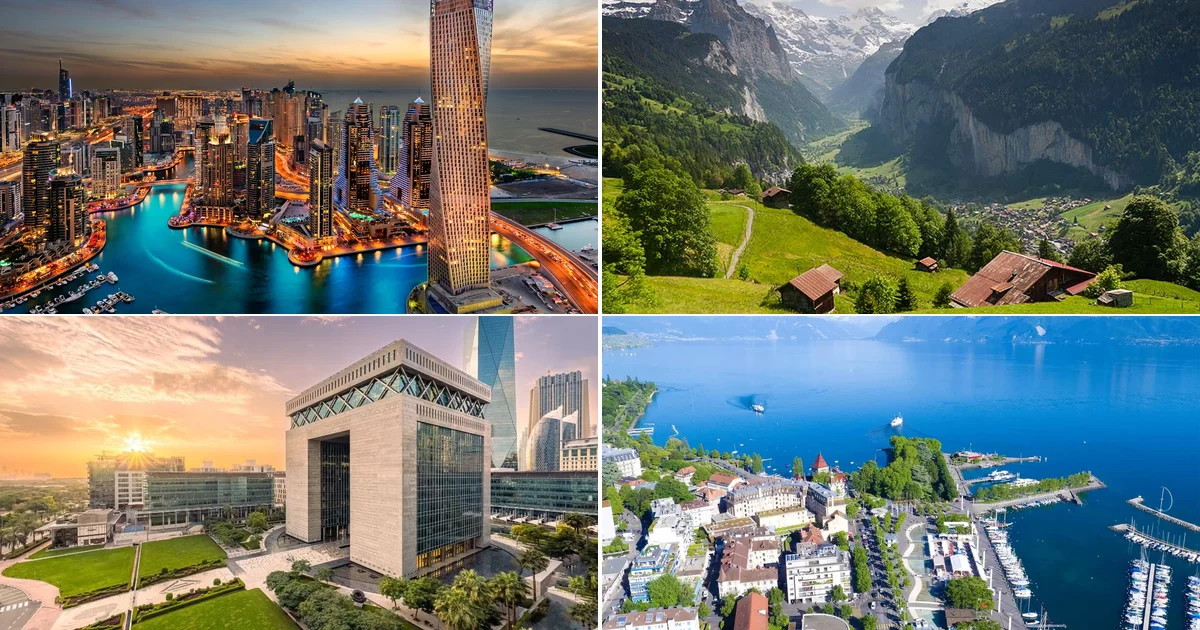
For an ultra-high-net-worth family planning 2026 and 2027, the UAE-or-Switzerland question is not really about where to live. It is about what the next decade of wealth is supposed to do. The UAE, and Dubai and Abu Dhabi in particular, has become the more obvious platform for deploying capital, expanding a business, running tax-efficiently, and moving fast. Switzerland still holds a stubborn edge in long-term protection, institutional familiarity, and the kind of stability families value more as portfolios grow larger and more multigenerational. By early 2026 the UAE had climbed to joint second place in Henley & Partners’ Global Residence Program Index, entering the top three for the first time. That is a signal: the country is no longer treated as a tactical stop, but as a serious residency jurisdiction for globally mobile wealth.
Within the UAE, Hudayriyat Island investment in Abu Dhabi is one of the more compelling recent entries.
The cleaner way to put it: the UAE is increasingly where wealthy families go to build, structure, and accelerate wealth. Switzerland is still where many of them prefer to consolidate, protect, and pass it on. Which is why the most sophisticated answer in 2026 is often not UAE or Switzerland, but UAE and Switzerland, each doing a different job on the same family balance sheet.
Direct answer
If the priority is capital growth, tax efficiency, entrepreneurial flexibility, digital-asset regulation, and luxury real estate upside, the UAE is usually the stronger fit. If the priority is legacy planning, legal continuity, conservative preservation, private-banking depth, and an established safe-retreat reputation, Switzerland remains hard to replace. In practice, many UHNW families now run the UAE as the operating and opportunity base while keeping Switzerland as the asset-protection and succession anchor.
| UAE, stronger fit | Switzerland, stronger fit |
|---|---|
| Capital growth and tax efficiency | Legacy planning and legal continuity |
| Entrepreneurial flexibility | Conservative wealth preservation |
| Digital-asset regulation via VARA | Private-banking depth |
| Luxury real estate upside | Established safe-retreat reputation |
| Fast-moving opportunity | Multigenerational succession |
UAE vs Switzerland for UHNW, quick comparison
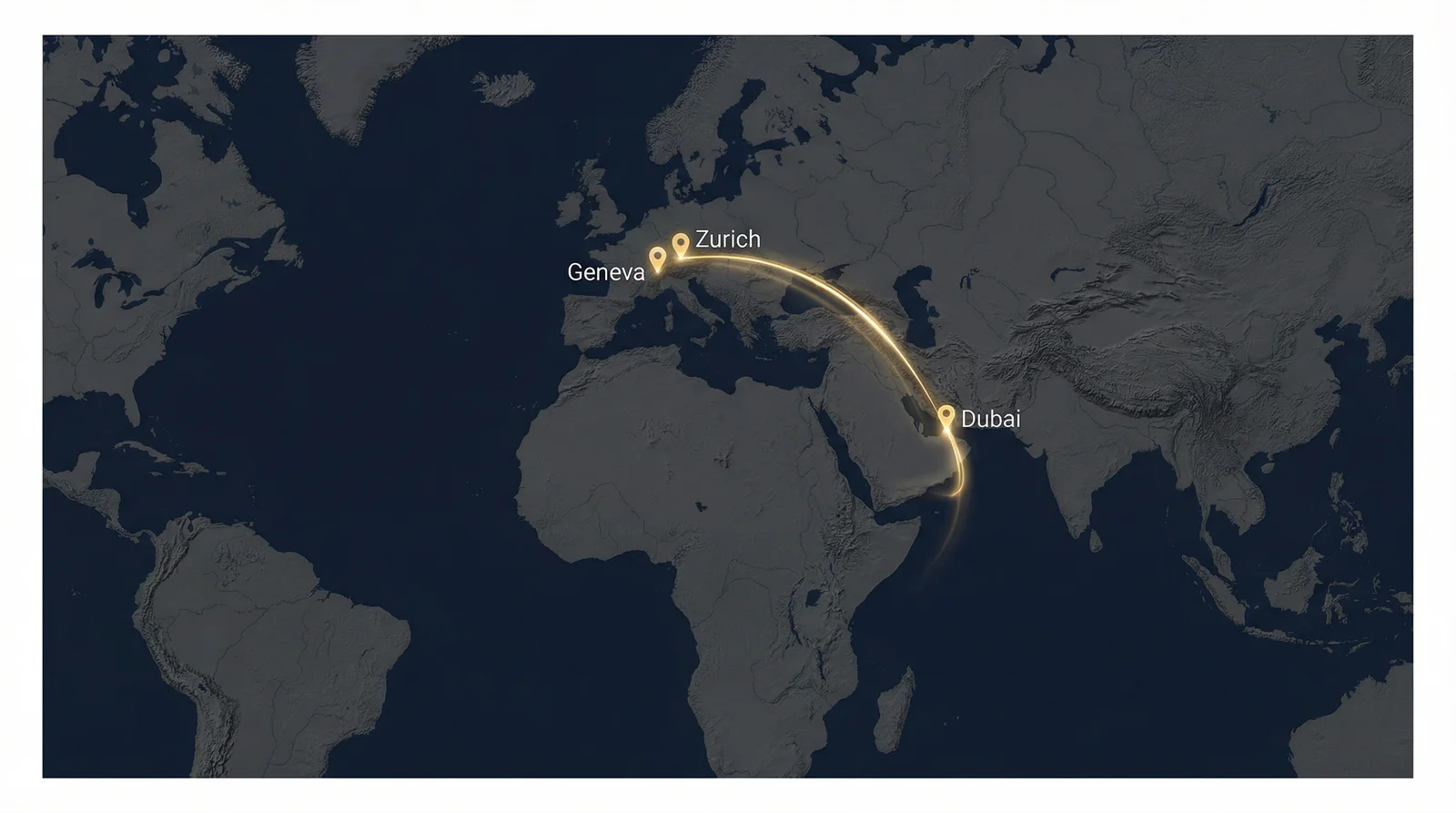
| Feature | UAE, especially Dubai and Abu Dhabi | Switzerland |
|---|---|---|
| Best fit | Growth, deal flow, mobility, tax efficiency | Preservation, continuity, succession, institutional depth |
| Personal income tax | 0% on individuals | Federal, cantonal, and communal taxes apply |
| Corporate framework | 9% federal corporate tax, with a 0% band up to AED 375,000 and 0% on qualifying free-zone income for qualifying free-zone persons | Effective corporate tax varies by canton, generally higher than the UAE |
| Residency angle | Golden Visa and other long-term residence pathways | Traditional residence planning, including lump-sum taxation for eligible foreigners |
| Digital assets | Stronger dedicated virtual-asset framework in Dubai via VARA | Respected, but more traditional and compliance-heavy |
| Wealth preservation | Improving rapidly, but newer in perception | Long-established global safe-retreat reputation |
| Banking reputation | Stronger every year, especially in DIFC and ADGM ecosystems | Still one of the benchmark jurisdictions in private banking |
| Real estate role | Often part of the strategy itself, lifestyle plus return potential | More defensive, selective, less growth-led in many cases |
| Family office logic | Excellent as a regional and global operating hub | Excellent as a long-term custody and legacy jurisdiction |
Table based on UAE government tax and residency guidance, VARA’s regulatory role, the Swiss federal tax framework, official Swiss neutrality guidance, Swiss lump-sum taxation rules, and 2025 to 2026 reporting on wealth flows and family-office positioning.
Why this comparison matters more in 2026 than it did a few years ago
A few years ago people framed this as a simple tax comparison. That was too shallow then and it is too shallow now. The UAE has matured. It now combines residence attractiveness, zero personal income tax, fast business formation, increasingly credible wealth-structuring ecosystems, and a deeper regulatory environment than critics admit. Dubai’s virtual-assets regime is the clearest example. VARA was established specifically to regulate and oversee virtual-asset activity in and from Dubai, which makes the UAE genuinely relevant for founders, digital-asset investors, and next-generation families who want operational flexibility, not legacy banking alone.
Switzerland has not lost its core appeal at the same time. It still runs on a durable reputation for political stability, rule of law, and neutrality as an instrument of policy. The Swiss government describes permanent neutrality as a source of peace and stability and as a protector of the country’s independence and territorial inviolability. That sounds abstract on paper, but for families thinking in generations rather than quarters, it matters more than people admit in public.
There is also an immediate 2026 context. Reuters reported in March 2026 that Swiss money managers expected increased inflows from Gulf-based wealthy individuals, because Switzerland still benefits from its safe-retreat reputation during regional stress. At the same time, 2025 reporting showed Swiss family offices and advisers looking toward Dubai for tax, regulatory, and business-environment advantages. Capital is moving in both directions, for different reasons. That is exactly why a serious UHNW comparison needs more nuance than the usual lifestyle piece.
| Direction | What is happening | Source |
|---|---|---|
| Swiss advisers to Dubai | Swiss family offices looking toward Dubai for tax, regulatory, and business-environment advantages | Financial Times, 2025 |
| Gulf wealth to Switzerland | Swiss money managers expecting increased inflows from Gulf-based wealthy individuals during regional stress | Reuters, March 2026 |
Part one: the UAE as a growth hub

The tax story is powerful, but it is not the whole story
The tax advantage is one of the UAE’s biggest draws and it would be artificial to pretend otherwise. The UAE does not levy income tax on individuals. On the business side, the federal corporate tax regime generally applies at 0% up to AED 375,000 of taxable income and 9% above that, while qualifying free-zone persons can still benefit from a 0% rate on qualifying income if they meet the conditions. For founders, principals, and internationally mobile families, that architecture can transform retained earnings, reinvestment capacity, and holding efficiency against higher-tax European structures.
But the deeper reason the UAE works for these families is speed. Business decisions move faster. Real estate launches move faster. Investor networks form faster. Bank introductions, free-zone structures, advisory ecosystems, and residency logistics feel far more immediate than in older financial centres. That velocity carries risk, of course. Faster jurisdictions can feel less settled. Still, for people whose wealth came from momentum rather than inheritance, that energy is often the attraction. It is why the comparison keeps landing on a simple line: Switzerland protects wealth, Dubai multiplies options.
| UAE tax framework | Rate | Detail |
|---|---|---|
| Personal income tax | 0% | No individual income tax |
| Corporate tax (standard) | 9% | Above the AED 375,000 threshold |
| Free zone (qualifying) | 0% | On qualifying income if conditions are met |
Residency has become much more strategic

The UAE’s long-term residency offer has become materially more credible. The official Golden Visa framework lets eligible individuals secure long-term residence, commonly five or ten years depending on category, with renewal pathways and without the old dependence on a local sponsor. That has changed how mobile families think about the country. It is no longer just a place for tax-residency engineering or a regional base. It is increasingly a serious family relocation destination once schooling, safety, business connectivity, and lifestyle sit in one jurisdiction.
This matters for real estate too. In the UAE, and especially Dubai, property is often not just a lifestyle asset. It can be part of the residency, portfolio, and status strategy at the same time, which is why investors working through this comparison tend to drill into Dubai waterfront and trophy stock, particularly in districts where branding, scarcity, and exit liquidity meet.
Why Dubai suits active principals and next-generation wealth
There is another layer that gets overlooked. Dubai fits the psychology of active wealth. Many principals do not only want efficiency, they want relevance: proximity to emerging markets, easier access to Asia, Africa, and the wider Middle East, and a place where capital, lifestyle, and visibility reinforce each other. Wealth commentary through 2025 and early 2026 increasingly described Dubai as a global family-office hub and gateway jurisdiction rather than just a low-tax city. That shift matters, because once advisers, private banks, lawyers, and operating teams follow the principals, the ecosystem gets stickier.
Part two: Switzerland as the preservation jurisdiction

If Dubai is where families keep wealth in motion, Switzerland is where they go when stillness itself becomes a premium product. That sounds dramatic, but it is basically true. Switzerland’s appeal is not that it is exciting, it is that it is dependable. Its tax system is well understood, though far from simple, because federal, cantonal, and communal layers all matter. Its residence logic is familiar to global advisers. Its private-banking heritage still carries weight. And for eligible foreign nationals not employed in Switzerland, expenditure-based, or lump-sum, taxation remains part of the toolkit.
In more practical terms
Switzerland solves a different problem than Dubai. It is not designed to feel fast, it is designed to feel dependable, and for a certain kind of family that difference is the whole point. The country combines federal, cantonal, and communal tax layers with a legal and financial system global advisers already know how to navigate. Less thrilling than the UAE, yes, but for wealth that is already created and now needs to be held, governed, protected, and passed on, the Swiss proposition is unusually strong. The Swiss federal tax administration itself stresses the multi-layered nature of the system, and the official tax calculator exists for a reason: the burden varies meaningfully by canton and municipality.
Not low tax, structured tax
This is where glossy comparisons get lazy. Switzerland is not the zero-tax story the UAE is. It is a planning story. For eligible foreign nationals who move there and are not gainfully employed in the country, expenditure-based taxation, often called lump-sum taxation, remains available. The Swiss federal finance department describes it as a simplified assessment procedure for foreign nationals domiciled in Switzerland who are not employed there. Important, but so is the nuance: it is not a universal shortcut, it is a specific regime with eligibility rules, cantonal differences, and a process that must be handled properly. Switzerland’s own materials note that some cantons abolished it while others kept it under stricter rules.
So for a UHNWI, the Swiss tax appeal is usually customisation, not simplicity. The family that does well there values predictability, residence quality, governance discipline, and careful cross-border structuring over raw after-tax acceleration. That suits principals who are de-risking, and second- and third-generation families thinking about stewardship rather than velocity. The UAE usually wins on immediate tax efficiency. Switzerland often wins on how comfortable sophisticated advisers feel building durable frameworks around residence, tax, inheritance, philanthropy, and banking.
Why Switzerland still feels safer to legacy-minded families
Part of the edge is rational, part cultural. Rationally, the country benefits from a long-standing reputation for neutrality, institutional continuity, and legal stability. The Swiss foreign ministry frames neutrality as a means of protecting peace, security, independence, and territorial inviolability. In practice that feeds the safe-jurisdiction instinct still shaping how many families allocate reserves, custody, and succession structures. When regions feel tense, the instinct gets stronger. Reuters reported in March 2026 that Swiss wealth managers expected increased inflows from Gulf-based individuals precisely because of that safe-retreat reputation during geopolitical stress.
Even so, I would not call Switzerland purely defensive. What it really offers is lower-friction trust. Families, boards, trustees, and private-bank teams understand what Switzerland is for. They know the rhythm, the standards, the sort of system they are entering. That familiarity has real value at scale. Past a certain level of wealth, fewer people chase novelty. They are trying to remove avoidable surprises.
Private banking, privacy, and the thing people still misunderstand
Switzerland remains a reference point in global private banking. The Swiss Bankers Association reports the sector manages CHF 9.3 trillion in assets and more than 20% of the world’s cross-border privately held assets, reinforcing the country’s position as a leading wealth-management hub. The association also noted in 2025 that Switzerland confirmed its status as the world’s leading location for cross-border asset management, with geopolitical uncertainty actually increasing demand for stability-led booking platforms. Those are not small signals, and they explain why Switzerland stays sticky in family-office conversations even when higher-growth jurisdictions get the headlines.
But privacy in modern Switzerland is not secrecy, and that old stereotype is increasingly wrong. Swiss Banking notes that Swiss banks have participated in the automatic exchange of information (AEOI) with foreign counterparts since 2017. The value proposition is no longer opacity. It is professionalism, process, custody discipline, sophisticated cross-border service, and a culture of discretion inside a highly compliant system. For serious families that is preferable. They do not want grey-zone mystique, they want quiet competence.
One more point that gets flattened in these debates: Switzerland is not anti-innovation. Its own banking materials emphasise digital assets, tokenisation, and blockchain-linked infrastructure as real opportunities, and Swiss market positioning has highlighted that Swiss banks were among the early institutions to gain digital-asset experience. So the contrast with Dubai is not innovation versus old money. Dubai’s digital-asset posture is more overtly jurisdiction-building and commercially branded, particularly through VARA’s dedicated framework. Switzerland’s is more embedded into an existing banking and compliance culture. Both are credible. They appeal to different temperaments.
| Swiss private banking scale | Figure |
|---|---|
| Assets under management by Swiss banks | CHF 9.3 trillion |
| Share of the world’s cross-border privately held assets | Over 20% |
Swiss Bankers Association, 2025.
Family-office logic: two jurisdictions, two different roles

This is where the comparison gets most interesting. Dubai has spent recent years building infrastructure aimed squarely at family businesses and UHNW structures. DIFC now promotes its Family Wealth Centre, family-office solutions, foundations, holding structures, wills and probate services, and a private register designed for confidentiality within a transparent legal framework. DIFC and Henley materials point to the scale of wealth now clustering there, including 120 family offices reportedly managing about USD 1.2 trillion, while EY’s GCC Wealth Management Industry Report 2025 described the UAE as the region’s leading wealth-management hub, with more than half of the GCC’s professionally managed wealth booked or managed there.
Switzerland rarely markets itself with the same visible ambition, partly because it does not have to. It already holds the trusted-vault-plus-advisory-depth position in most people’s minds. So when families compare the two, they are often not deciding which single jurisdiction should do everything. They are deciding which jurisdiction should do which job. The Financial Times reported in 2025 that some Swiss family offices were looking to move to Dubai under tax and regulatory pressure, while Reuters reported in March 2026 that Gulf wealth was heading toward Switzerland as regional tensions rose. Those flows are not contradictory. They point to functional specialisation: Dubai for operating capital and opportunity, Switzerland for reserve capital and continuity. Not a rule, but a recognisable pattern.
| Dubai, operating capital and opportunity | Switzerland, reserve capital and continuity |
|---|---|
| Active investment, deal origination, and growth-oriented family-office operations | Succession architecture, banking relationships, and long-horizon preservation planning |
Real estate changes the equation, and the UAE has the cleaner story
For a real estate-led relocation, the UAE is usually easier to understand. Property can carry lifestyle positioning, residence planning, portfolio diversification, and a capital-growth thesis all at once. Switzerland is more complicated. Official Swiss guidance is clear that not all foreign nationals are free to buy, that some acquisitions require authorisation under the Lex Koller framework, and that buying Swiss property does not grant a residence permit. The Federal Office of Justice states that acquisition by foreign non-residents generally requires authorisation from the competent cantonal authority.
That does not make Swiss real estate unattractive. It simply plays a different role in the decision tree. Swiss property is usually not the clean front door to residence, nor is it commonly used the way Dubai real estate is, as an operational and strategic bridge between residence, lifestyle, and investment momentum. If the move is heavily property-led, and especially if the family wants growth-oriented luxury waterfront stock, the UAE is typically the more natural fit.
UHNW decision matrix: who tends to prefer what
| UHNW priority | UAE, especially Dubai and Abu Dhabi | Switzerland |
|---|---|---|
| Maximise after-tax income and reinvestment | Stronger fit | Weaker fit |
| Build or relocate an operating business | Stronger fit | Selective fit |
| Establish a regional family-office platform | Stronger fit, especially via DIFC and ADGM | Strong fit, but less growth-led in image |
| Conservative custody and cross-border private banking | Improving fast | Stronger fit |
| Succession, governance, long-horizon continuity | Good, improving | Stronger fit |
| Digital assets and virtual-asset ecosystem | Stronger fit for founders and active allocators | Strong fit for bank-integrated, compliance-led exposure |
| Trophy real estate linked to relocation and growth | Stronger fit | More restricted and less residency-linked |
| Safe-retreat perception during geopolitical stress | Good, but more region-sensitive | Stronger fit historically and in current flow patterns |
Not absolute, but it reflects the institutional positioning visible across official and industry sources in 2025 and 2026. The UAE is now a more complete wealth jurisdiction than old assumptions allow, while Switzerland still dominates where continuity, custody, and conservative confidence matter most.
An honest interim conclusion
So, UAE or Switzerland for UHNW families in 2026 and 2027? It depends on whether the family is still in the expansion phase or has entered the preservation phase. Most are somewhere in between, which is why the best answer is usually layered. The UAE is hard to beat for efficient structuring, deal velocity, residence flexibility, and growth-oriented real estate and business exposure. Switzerland is hard to beat for trusted custody, private-banking depth, succession architecture, and safe-retreat optionality. The more sophisticated the family, the less likely they are to ask one jurisdiction to do everything.
UAE real estate strategy for UHNW families
The UAE advantage becomes most visible once real estate enters the conversation. In Switzerland, property is often an extension of residence and lifestyle, but it is not always an easy or flexible entry point for non-residents, and official guidance is clear that buying does not itself create a residence right. In Dubai the logic is more direct. Property can be a lifestyle asset, a capital-allocation tool, a visibility signal, and in some cases part of a residency strategy. That is a big reason Dubai keeps attracting principals who want their residence base to be commercially useful, not just comfortable.
That difference changes behaviour. In the UAE many families do not separate the relocation plan from the property strategy. They start with residence and tax efficiency and quickly move to the real questions: which district holds value best, where luxury supply is becoming genuinely scarce, which waterfront communities still have pricing upside, and which branded residences are substance rather than packaging. The right choice can materially shape the quality of the move, the liquidity of the portfolio, and the family’s ability to anchor itself in the jurisdiction.
Why Dubai Islands fits this comparison well
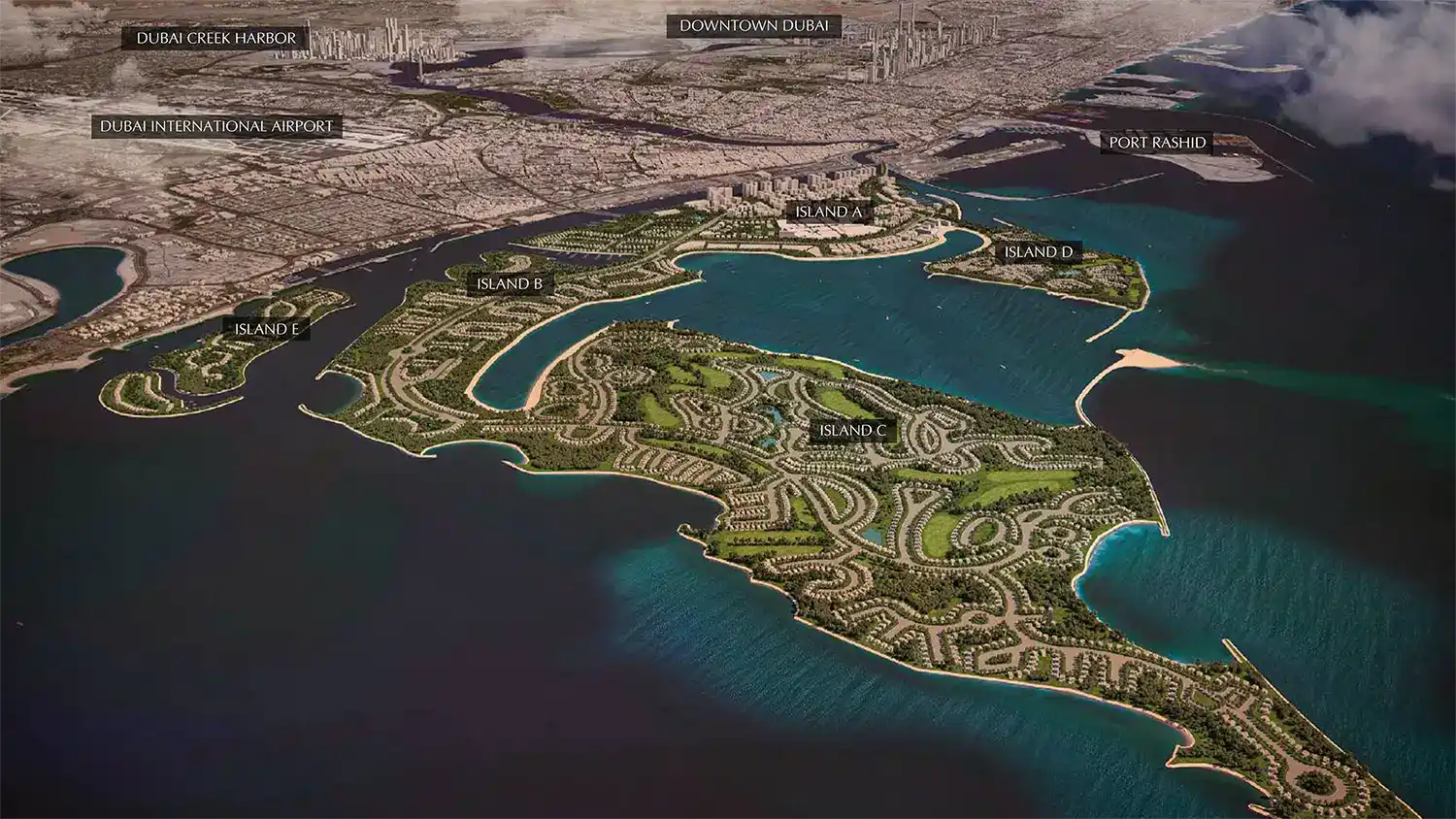
Dubai Islands is worth naming because it sits in the middle of several themes these families care about: waterfront living, master-planned scarcity, lifestyle-led appreciation, and long-horizon positioning rather than speculative turnover. It tends to appeal to buyers who want exposure to Dubai’s luxury waterfront growth without defaulting to the most mature trophy districts. That fits the broader UAE thesis. Dubai often rewards families who position early in districts where infrastructure, branding, and demand drivers are still maturing. Switzerland rarely offers that kind of real estate narrative. It offers defensiveness, prestige, and stability. Dubai still offers repricing potential.
Dubai vs Switzerland on lifestyle, family life, and schooling
Lifestyle comparisons get superficial fast. One article says Dubai is energetic and Switzerland calm, another says modern versus timeless. Broadly true, not especially useful. For these families the better question is how daily life supports the family’s actual objectives.

Dubai suits families who want optionality, international connectivity, hospitality-led living, and a service-oriented environment. Its private education sector is large and diverse. KHDA reported that Dubai’s private schools held 387,441 students across 227 private schools in the 2024-25 academic year, which says something about scale and choice. Multiple curricula, strong expatriate infrastructure, and a market built for globally diverse residents are part of why Dubai works for mobile international families. KHDA also runs a parent guidance service and a public school directory, which makes the process more transparent than newcomers expect.
Switzerland suits families who value environment, rhythm, discretion, and educational depth with a more traditional tone. The Swiss Federation of Private Schools notes that Swiss private schools educate nearly 100,000 pupils from Switzerland and more than 100 other countries, and its international schools guide is widely used by embassies, guidance offices, and international organisations. So the Swiss offer is not niche, it is different: more boarding-school-oriented, more classically European, often better aligned with families who want distance from noise rather than proximity to deal flow.
| Education at a glance | Dubai | Switzerland |
|---|---|---|
| Scale | 387,441 students across 227 private schools (KHDA 2024-25) | Nearly 100,000 pupils from 100+ countries (Swiss Federation of Private Schools) |
| Character | Multiple curricula, strong expat infrastructure, built around globally diverse residents | Boarding-school-oriented, classically European, suited to families wanting distance from deal flow |
So lifestyle should not be reduced to weather and scenery. Dubai is often better for families who want a city that behaves like an economic engine. Switzerland is often better for families who want their environment to slow things down. Neither is universally better. They produce different habits, and over time habits shape how families spend, invest, and organise themselves.
A realistic relocation framework
Choose the UAE first if most of these are true
- You still want to grow capital aggressively.
- You want zero personal income tax as a core planning benefit.
- You value easy proximity to business hubs across the Middle East, Asia, and Africa.
- You want a stronger digital-asset and founder-friendly regulatory narrative, especially in Dubai through VARA.
- You expect real estate to be part of the wealth-building strategy, not just the lifestyle layer.
- You want residency pathways that support a modern international family setup, including long-term options such as the Golden Visa.
Choose Switzerland first if most of these are true
- You are more concerned with preserving wealth than accelerating it.
- You value private-banking depth and adviser familiarity.
- You want long-horizon continuity for governance, succession, and reserve capital.
- You are comfortable with a structured, canton-sensitive tax environment rather than a low-tax one.
- You prefer the cultural tone of discretion, lower noise, and historical institutional trust.
- You want a jurisdiction that tends to gain appeal when the world feels unstable.
Choose both, in a dual-jurisdiction structure, if this sounds familiar
- You run active businesses, investment vehicles, or operating capital from the UAE.
- You maintain reserve assets, succession architecture, or banking relationships in Switzerland.
- You want one jurisdiction optimised for motion and another for stillness.
- You do not want all family, business, and asset functions concentrated in one country.
This is not an official program category. It is an inference from how capital and family-office behaviour are moving. But it is a sensible inference, and increasingly a practical one. The 2025 and 2026 reporting on family offices, Gulf capital, Dubai’s wealth ecosystem, and Switzerland’s safe-retreat role all point that way.
Practical relocation checklist for 2026-2027
The mistake many families make is comparing the two jurisdictions in the abstract. Build the move around the family’s actual operating model instead.
- Define the family objective first. Tax efficiency, growth, schooling, succession, banking, or geopolitical optionality? It is rarely just one thing.
- Separate operating capital from preservation capital. The UAE often works better for operating structures and active wealth. Switzerland often works better for reserve capital and continuity.
- Check the residence mechanics early. In the UAE, visas range from standard sponsored options to 5- and 10-year frameworks depending on category. In Switzerland, staying longer than three months generally needs a permit, with cantonal migration offices handling issuance.
- Do not assume property solves residence everywhere. In Switzerland, acquisition by foreign non-residents can require authorisation, and ownership does not itself grant a residence permit. In the UAE, property can be far more central to the relocation.
- Choose schooling before the house, not after. It sounds mundane, but it is one of the most consequential decisions in any family move. Dubai offers enormous private-school breadth. Switzerland offers depth, prestige, and a more traditional tone.
- Treat tax and legal advice as jurisdiction-specific. Switzerland is canton-sensitive. The UAE is federal, but outcomes still depend on entity choice, free zone versus mainland, banking, and source of income. The more wealth involved, the more dangerous simple online summaries become.
Final conclusion
If the question is truly UAE or Switzerland for UHNW in 2026 and 2027, the honest answer is this: choose the UAE when wealth is still expected to move, grow, compound, and engage with new opportunity. Choose Switzerland when wealth is expected to hold, endure, protect, and transition across generations. Choose both when the family is large enough, sophisticated enough, and globally exposed enough to need separate jurisdictions for different functions.
That may sound like a compromise. It is not. It is often the most intelligent structure. For some families Dubai becomes the actual centre of gravity. For others Switzerland remains the emotional and institutional anchor. For a growing number, especially globally mobile families with business, property, and governance needs across regions, the future is not a single-flag answer. It is a deliberate architecture.
FAQs
Is the UAE better than Switzerland for UHNW tax planning?
For pure personal tax efficiency the UAE is usually more attractive, because it does not levy personal income tax, while Switzerland applies federal, cantonal, and communal taxes, though certain eligible foreigners may access lump-sum taxation.
Is Switzerland still better for wealth preservation?
In many cases, yes. Switzerland still benefits from a strong safe-retreat reputation, deep private-banking infrastructure, and long-standing trust around legal continuity and asset protection.
Is Dubai better for active investors and entrepreneurs?
Usually, yes. Dubai is more naturally aligned with founders, operating businesses, growth-oriented investors, and principals who want tax efficiency, long-term residency options, and faster-moving capital opportunities.
Can UHNW families use both the UAE and Switzerland?
Yes, and many increasingly do. It is not an official dual-jurisdiction program, but current wealth-flow and family-office reporting suggests families use the UAE for operational income and strategic growth while keeping Swiss structures for preservation and succession.
Is buying real estate in Switzerland the same as buying in Dubai for relocation?
No. In Switzerland, acquisition by foreign non-residents can require authorisation, and buying property does not itself grant a residence permit. In Dubai, property can be far more central to the residency and relocation discussion.