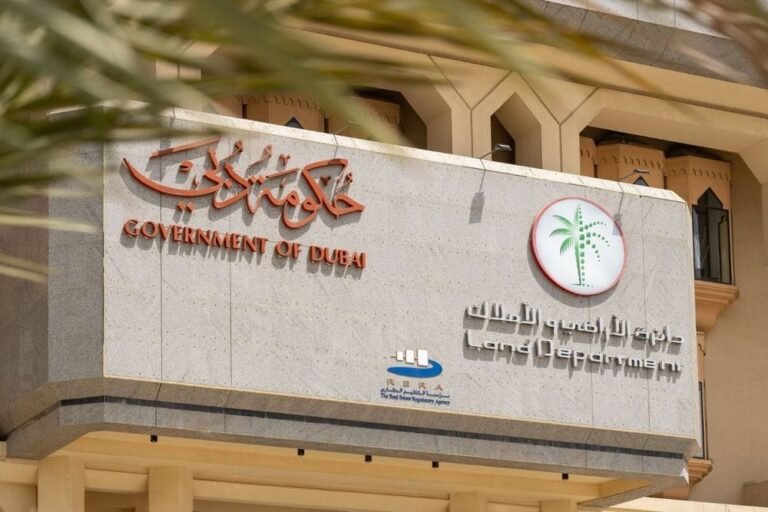


The Dubai Land Department fees are the line most buyers forget until the money is already committed. They are not huge as a percentage, but they land on top of the purchase price, they are due in cash, and they change the real cost of getting in and out of a property. If you are underwriting a Dubai purchase, treat them as part of the price, not an afterthought at signing.
The Dubai Land Department (DLD) is the body that records transactions, enforces legal compliance, and charges the fees that make the register work. Below is what each fee is, what it costs, and why it matters to your return. If you want the wider buying process first, start with our country guides:
- The UK Investor’s Guide to Buying Property in Dubai
- The US Investor’s Guide to Buying Property in Dubai
- The Canadian Investor’s Guide to Buying Property in Dubai
What DLD charges actually cover
DLD regulates real estate transactions in Dubai, and its fees pay for the legal and procedural work behind them: transferring ownership, registering the property, and keeping every deal officially recorded. That record is the point. It is what protects both sides of a transaction and what funds the system that makes Dubai’s property market as traceable as it is. The main charges are registration fees, the title deed fee, mortgage registration fees, and a set of administrative and service fees.
The fees, broken down
The structure is straightforward, but the numbers add up with the value of the property.
| Fee | Amount | Who typically pays |
|---|---|---|
| Registration (transfer) fee | 4% of the sale price or appraised value, whichever is higher | Usually split, 2% buyer and 2% seller |
| Title deed fee | AED 500 to AED 1,000 | Buyer |
| Mortgage registration fee | 0.25% of the mortgage amount (minimum AED 250, maximum AED 10,000) | Buyer |
| Administrative and service fees | AED 200 to AED 1,000 | Buyer |
Registration fee
This is the big one, and it applies to both buyer and seller. DLD charges it to officially record the sale and the transfer of ownership in the land registry. The total is 4% of the sale price or the appraised value, whichever is higher, and it is typically shared equally, so each side pays 2%. On a property valued at AED 1,000,000, the total registration fee is AED 40,000: AED 20,000 from the buyer and AED 20,000 from the seller.
Title deed fee
Once the transaction completes, the buyer receives a title deed as proof of ownership. This fee covers issuing that deed and having it legally recognised. It runs from AED 500 to AED 1,000 depending on the property’s value and the complexity of the transaction, and it is generally paid by the buyer.
Mortgage registration fee
If you finance the purchase, DLD charges a fee to register the mortgage, which creates a legal record of the lender’s claim on the property. It is 0.25% of the mortgage amount, with a minimum of AED 250 and a maximum of AED 10,000. On a mortgage of AED 500,000, that comes to AED 1,250.
Administrative and service fees
Across the transaction you will hit smaller charges for document verification, processing, and paperwork such as non-objection certificates. These typically run from AED 200 to AED 1,000 depending on the service. In more complex deals or large-scale developments, add legal fees, service charges, and the cost of various permits and certificates.
Why these numbers change your return
DLD fees are a real part of ownership cost, and they can shift whether a deal makes sense. A few things to hold onto:
Budget for them from the start
The fees sit on top of the purchase price and run into tens of thousands of dirhams on a mid-market property. Leave them out of your budget and you are short at exactly the wrong moment.
They eat into ROI
Registration and transfer fees in particular add to your cost basis, which lowers the profit on any exit. Fold them into your return calculation from day one rather than discovering them later.
They shape strategy
Whether you are buying a luxury unit, an affordable apartment, or land to develop, the fee load is part of the true entry price. Knowing it up front is what lets you judge whether a property is actually worth what you are paying.
They matter when comparing deals
Because charges scale with the type and value of the property, two options at similar headline prices can carry different total costs. Run the fees on each before you compare, or the comparison is incomplete.
The market these fees sit inside
The fees are easier to accept once you see what you are buying into. A few things keep Dubai attractive to both investors and end users.
A diversified economy
Finance, tourism, and trade underpin demand for property here, which gives the market a steadier base than a single-sector city would.
The tax position
No capital gains tax, no inheritance tax, no annual property tax. For investors focused on net return, that structure does a lot of the heavy lifting, and it partly offsets the transaction fees above.
Government policy
The UAE has eased foreign ownership rules, launched the Golden Visa, and pushed sustainable, higher-quality development, all of which support the market.
Location and lifestyle
Dubai sits at the crossroads of Europe, Asia, and Africa, with strong infrastructure and a workable time zone for global business. Add the residential quality and amenities, and you have a market that pulls in businesses, entrepreneurs, and residents.
Where the market is heading
A few trends are worth tracking as you buy.
Off-plan demand
Off-plan continues to draw investors in developments like Dubai Creek Harbour, JVC, and Meydan, mainly for the flexible payment plans, the lower upfront cash, and the potential for capital appreciation before handover.
Sustainability
Government initiatives are pushing energy-efficient buildings, green space, and smart-home technology, which is drawing a more eco-conscious buyer.
The luxury segment
High-net-worth demand keeps concentrating in Palm Jumeirah, Downtown Dubai, and Dubai Marina, which continues to fuel high-end development in those areas.
Regulation and transparency
The registration process keeps getting more digital, and policy is increasingly geared toward long-term foreign investment. If you want the current rules and where the opportunities sit, join one of our webinars to see how to get started.
The bottom line
DLD charges are not the reason a Dubai deal works or fails, but they are the reason a deal that looked clean on paper can come up short in cash. Price them in early, put them in your ROI, and compare them across options. Do that and the fees become what they are meant to be: the cost of a market that records everything and protects both sides, rather than a surprise at the counter.