


Dubai does not send you a yearly property tax bill just for owning. What owners actually deal with is annual service charges, and tenants see a 5% housing fee applied to rent and collected through DEWA. That is the first thing to get straight, because a lot of buyers arrive expecting the cost structure they know from home and then get caught by a different set of line items.
The word “fees” hides at least ten separate things, and each step of a purchase carries its own small charge. Individually most of them are not large. Together they are enough to blow a budget you thought was tidy. So the goal of this guide is simple: know your cash needed to close before you fall in love with a unit.
If you want, WhatsApp me your budget and preferred areas, and I’ll send a simple buyer cost sheet and help you buy step by step.
The short answer on Dubai property fees
For a resale purchase, plan around 7% to 10% of the purchase price all-in. That range holds up because it captures the 4% DLD fee plus the trustee, broker, and small admin lines that always show up together. Off plan can feel lighter in the moment because of payment plans, but the government registration, admin, and handover setup costs are still there. They just land on a different schedule.
The 30-second checklist
- DLD fee: 4% of purchase price, plus admin, commonly cited as AED 580 for many ready apartments and offices
- Trustee and registration: commonly AED 2,000 under AED 500k or AED 4,000 above AED 500k, plus 5% VAT
- Agent commission: often 2%, with VAT on the service
- NOC fee: often AED 500 to AED 5,000, when the developer requires it
- If mortgage: 0.25% of the loan amount plus AED 290 mortgage registration, plus bank fees and valuation
- If off plan: registration runs through Oqood, the 4% still applies, but timing and admin look different
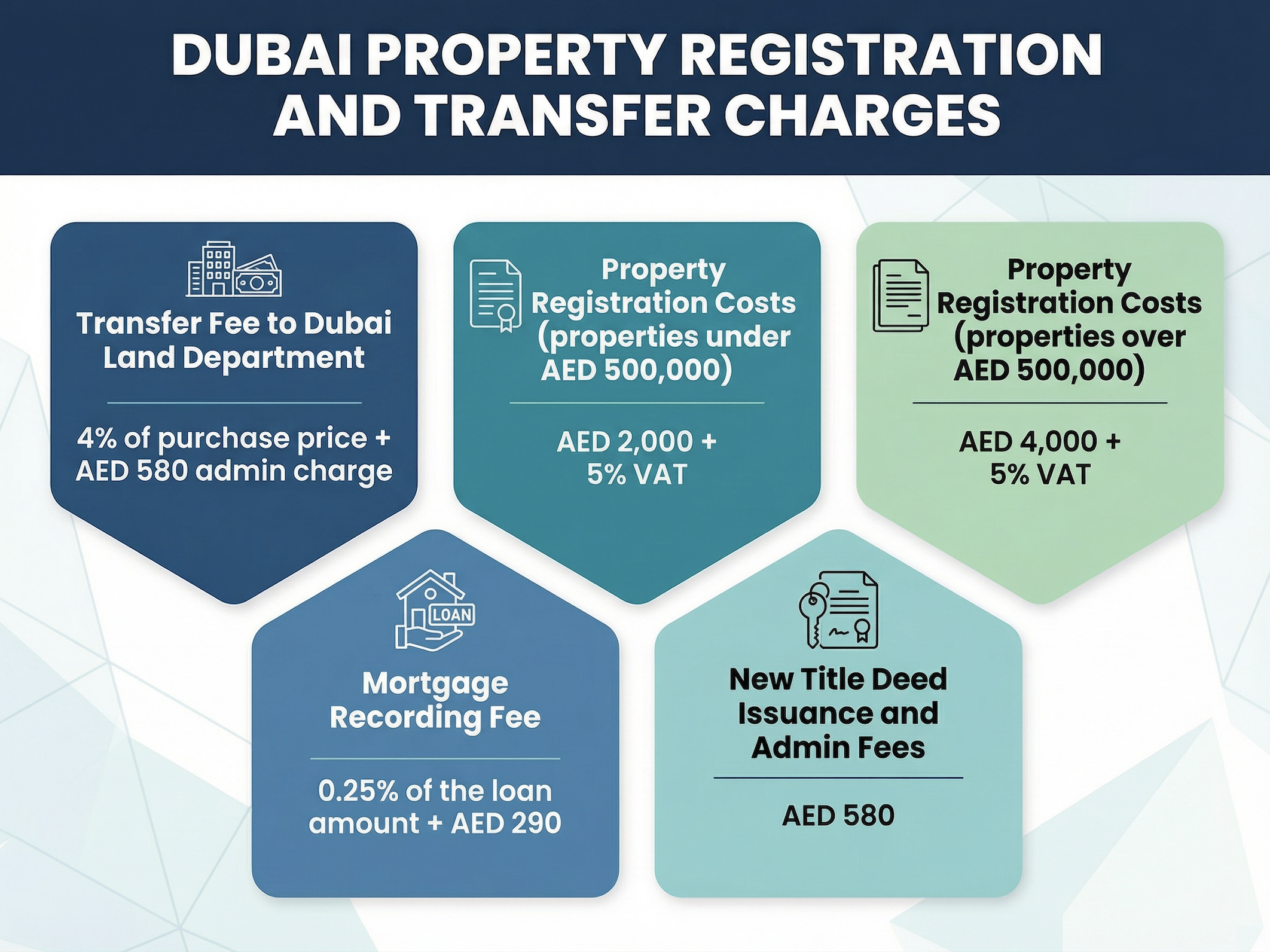
The three fees that surprise people most are the trustee and admin charges, because they feel small until you see them stacked together; the mortgage add-ons, because buyers fixate on the interest rate and forget the arrangement fee and valuation; and the service charges, because they hit after you own and quietly reshape your net yield.
WhatsApp me the listing link and price, and I’ll tell you the real cash needed to close, and whether the fee stack looks normal.
What each fee actually means
DLD fee. The main government fee. The headline is 4% of the purchase price, with a fixed admin charge on top, often cited as AED 580 for many ready apartments and offices. People call it a “transfer fee” because it registers the ownership transfer with DLD. In real deals the buyer pays it, unless the contract explicitly splits it.
Title deed fee. On a ready transfer you receive a title deed in your name once the transfer is processed. The issuance fee is usually a fixed amount, commonly referenced around AED 580 for many ready units.
Trustee office fee. A trustee office is a DLD-authorised partner that processes the transfer. Fees run in value bands, often AED 2,000 for properties under AED 500,000 and AED 4,000 above AED 500,000, plus VAT.
Oqood fee. The off plan registration pathway. Off plan does not mean no DLD cost. It usually means the timing and paperwork differ. Most budgeting still anchors the government cost around the 4%, though off plan admin can vary and some launches subsidise part of it as a promotion.
NOC fee. Some developers require a No Objection Certificate before ownership can transfer. It varies by developer and project, commonly AED 500 to AED 5,000.
Mortgage registration fee. If you finance, DLD charges 0.25% of the loan amount plus AED 290.
Valuation fee. Banks require a valuation before final approval, commonly AED 2,500 to AED 3,500 plus VAT where applicable.
Agent commission. For most resale transactions the norm is 2% brokerage on residential sales, with VAT on the service.
Service charges. The yearly ownership cost investors underestimate most. They vary by building and community and hit your net yield directly. Two towers that look identical in photos can carry very different charges depending on amenities and how well the building is run.
Ejari fee. Tied to rental contract registration, so it matters when a unit is let long-term. Planning ranges sit roughly AED 155 to AED 220 depending on channel. Small, but it comes up in real budgeting constantly.
DEWA deposit. A move-in cost, commonly AED 2,000 for apartments and AED 4,000 for villas. Not a purchase fee, but it lands at the same time as everything else, so it belongs in the budget.
One-time costs snapshot
| Fee item | Typical amount | Notes |
|---|---|---|
| DLD fee | 4% + admin (often AED 580 for ready units) | Core government fee |
| Trustee and registration | AED 2,000 or AED 4,000 + VAT | Value banded |
| Mortgage registration | 0.25% of loan + AED 290 | Only if mortgage |
| Valuation | AED 2,500 to AED 3,500 | Only if mortgage |
| NOC | AED 500 to AED 5,000 | Developer dependent |
Buying a ready property, the full breakdown
Buying ready is the cleanest version of the story. You agree the price, get the NOC if required, transfer at a trustee office, and walk away as the owner. The catch is that several costs land close together rather than spread out nicely, so “fees” suddenly feels real on transfer day.
The way people actually experience it: the offer is accepted and paperwork begins. You are not paying DLD yet, but you should already be calculating it, because it scales with price and it is the big lever. I set up a rough closing-budget sheet the moment a price is agreed. Even a draft stops the awkward surprises later.
Then, if the developer requires it, comes the NOC stage. The fee is usually in the AED 500 to AED 5,000 range, but the bigger issue is timing. Some NOCs are quick and some take longer than people expect. At the transfer appointment, most of the purchase fees hit at once: the 4% DLD fee plus admin, the trustee fee of AED 2,000 or AED 4,000 plus VAT depending on the value band, title deed and admin items, and the agent commission, typically 2% plus VAT, often collected around transfer.
If your transfer is coming up, WhatsApp me “TRANSFER DAY” and I’ll send a checklist of what to prepare and which fees usually show up.
Who pays what
The typical pattern, though you should always confirm in writing for your own deal:
- Buyer often pays: DLD fee and admin, trustee fee, buyer-side agent commission if the deal is structured that way, mortgage registration and valuation if financing, and the NOC fee where the agreement places it on the buyer.
- Seller often pays: seller-side agent commission, mortgage release and clearance costs on any existing loan, and some developer admin items tied to the seller.
The word “usual” is not what matters. What matters is what your contract says. If it says the seller pays X, that is the version that counts. Ask for a buyer cost sheet that states who pays what before you commit.
The NOC, and why resale has an extra hoop
The NOC exists so the developer can confirm nothing is outstanding that would block the transfer, often unpaid service charges. When you are shortlisting buildings, ask early: is an NOC required, what’s the fee, and what’s the timeline here? That one question can save you days.
If you finance the purchase
A mortgage adds cost and coordination. The fees to plan for are the mortgage registration of 0.25% of the loan amount plus AED 290 to DLD, a bank arrangement fee of up to 1% of the loan plus VAT, and a valuation of AED 2,500 to AED 3,500 plus VAT. Even with a good rate, those affect your up-front cash.
| Item | Cash buyer | Mortgage buyer |
|---|---|---|
| DLD fee and trustee | Yes | Yes |
| Bank valuation | No | Yes |
| Mortgage registration | No | Yes |
| Bank arrangement fee | No | Yes |
| Timeline risk | Lower | Slightly higher, due to bank steps |
WhatsApp me the price and loan percentage, and I’ll calculate your true down payment plus every mortgage fee, so you know your cash-to-complete.
If the unit is tenanted
Tenanted units are common in investor-heavy areas. Buying one is neither good nor bad by default. It depends on the rent level, the contract terms, and your plan. For fees, the things to check are whether the tenancy is registered properly under Ejari, whether there are outstanding bills or service charge balances, and what the handover plan is for keys, access cards, parking remotes, and building approvals. Ejari fees themselves are small. The operational friction is bigger than people expect if the paperwork is messy.
Resale buyer fee sheet, confirm these in writing
- Purchase price and buyer name spelled exactly as the passport
- DLD fee estimate and admin
- Trustee fee band and VAT
- Commission percentage, VAT, and payment timing
- NOC requirement, fee, and timeline
- If mortgage: arrangement fee, valuation, mortgage registration
- Any conveyancing support, if you use it (commonly AED 6,000 to AED 10,000)
Off plan fees, Oqood and developer charges
Off plan feels oddly relaxing at the start because you are thinking in instalments: payment plan, launch price, handover date, done. Then the extra lines appear, admin fees, registration timing, sometimes resale transfer rules, and the deal gets real. None of this is meant to scare you. Off plan can be excellent with the right developer and phase. But “I didn’t expect that fee” is the exact sentence that makes buyers hesitate at the worst moment, so budget properly.
The common misconception is that off plan lets you avoid the 4%. It doesn’t. You still plan around the 4% DLD registration cost, but the payment often happens earlier, at the registration stage rather than at handover. The second misconception is that Oqood is a random extra fee. It isn’t a vibe, it’s the registration system and process before a title deed exists, and it carries a cost and a timeline.
Developer admin fees are where off plan deals vary a lot, which is exactly why you should never compare projects on price alone. They can cover file opening or buyer onboarding, SPA processing and document issuance, registration handling and Oqood coordination, and sometimes master community processing. Some developers bundle it into one clean line, others split it across several. Get the total written down early. Often the fees are not high, but a messy presentation alone makes buyers nervous, and clarity fixes that.
WhatsApp me your shortlist, even two or three projects, and I’ll compare the real fee stacks side by side.
Direct from developer versus off plan resale
Buying direct is usually the cleanest, especially at launch: predictable payment milestones, predictable registration, less friction. Off plan resale can be a strong opportunity, but it can carry extra rules. You may need developer approval, there may be transfer rules, and there can be additional fees on the transfer. If you buy with any intention of reselling before handover, you want the resale policy now, not after your first instalment. Ask two things early: when can I resell, is it after a certain percentage is paid, and what are the transfer charges and approval steps? Even if you never sell, knowing the rules makes the whole thing calmer.
Handover and move-in costs
At handover the purchase fees fade and the real-life costs appear. Plan for the DEWA deposit, around AED 2,000 for apartments and AED 4,000 for villas, plus moving, snagging, and basic furnishing if you want to rent quickly. If you plan to let the unit, especially short-term, budget for the first few weeks of things that were not quite perfect at handover, curtains, lighting, a minor fix here and there.
| Fee bucket | Typical range or rule | When it hits |
|---|---|---|
| DLD registration cost | 4% of price, plus admin | Often early, during registration |
| Oqood registration path | Process and admin differ by developer | During off plan registration steps |
| Developer admin fees | Varies by developer and project | Early, around onboarding and SPA |
| Off plan resale transfer charges | Project dependent | If you resell before handover |
| Handover setup | DEWA deposit, move-in, snagging | At handover or just after |
The DLD transfer fee, calculated
You can’t avoid it on most normal purchases, but you can avoid the stress around it. The planning formula for a ready resale is: DLD fee = 4% x purchase price + admin, commonly cited as AED 580 for many ready units. So on a price of AED 2,000,000, the 4% component is AED 80,000, then admin is added.
Joint buyers, companies, and Power of Attorney cases don’t change the fee basis, which stays anchored to the transaction value, but they do add paperwork. Joint buyers need names matching passports exactly and the ownership split documented correctly. Company purchases involve a trade licence, authorised signatory proof, and corporate resolutions, so the timeline runs longer because the documents have to be clean. POA transactions are smooth when the POA is correctly prepared, attested where required, and accepted for that specific purpose, and they stall when it is vague or mismatched. If your purchase is joint, company, or POA, WhatsApp me and I’ll tell you the exact documents to prepare so transfer day stays smooth.
The unglamorous truth is that the main cause of delays is not the DLD fee. It’s a paperwork mismatch, and it’s always something small. Passport names must match across every document, buyer contact details must be correct on the forms, the bank’s final letter must be ready if there’s a mortgage, the NOC timeline must be confirmed early, and a POA must be accepted for property transfer specifically, not generic.
Mortgage fees, what changes when you finance
Buying with a mortgage is very doable and can still feel smooth. You just budget for two things at once: the fees and the timeline choreography. Cash deals are like walking. Mortgages are like walking while holding a coffee, still fine, just don’t sprint.
The mortgage registration fee catches people off guard because it is tied to the loan amount, not the property price: 0.25% of the loan plus AED 290. On a AED 1,500,000 loan that’s AED 3,750 plus AED 290 admin. It’s one reason two buyers can purchase the same unit and end up with different closing totals, because their loan sizes differ. On top of that, plan for a bank arrangement fee of up to 1% of the loan plus 5% VAT and a valuation of AED 2,500 to AED 3,500 plus 5% VAT. Some banks also require certain insurance items. Budget for arrangement plus valuation plus DLD mortgage registration and you’re usually in a safe place.
| Mortgage cost item | Typical rule of thumb |
|---|---|
| DLD mortgage registration | 0.25% of loan + AED 290 |
| Bank arrangement fee | Up to 1% of loan + VAT |
| Valuation | AED 2,500 to AED 3,500 + VAT |
Treat pre-approval as a green light, not the finish line. It tells you the bank likes you, but final approval still depends on the property, the valuation, and final credit checks, which means a few extra steps a cash buyer doesn’t face: valuation scheduled and completed, final offer letter issued, and the transfer appointment timed so nothing sits idle. And later, if you sell or refinance, you may face bank clearance and mortgage release steps. Not a deal breaker, just part of the lifecycle worth knowing about, because sellers sometimes forget they need time for mortgage clearance before transfer.
WhatsApp me “MORTGAGE FEES” and your target price, and I’ll run the exact stack and tell you the cash you need before transfer day.
Service charges and the recurring costs of ownership
This is the section that separates a nice investment on paper from a good one in real life. Service charges are not dramatic. They are consistent, and because they repeat every year they deserve attention.
They cover the shared running costs of the building or community: security and building staff, cleaning and common-area upkeep, maintenance of lifts, lobbies, pools, gyms and landscaping, and sometimes chilled water or district cooling components depending on the setup. Two similar-looking buildings can charge very differently because their operating models differ. Counterintuitively, the newer, shinier tower often costs more to run because it has more amenities, higher staffing, and more complex systems. Older buildings can get expensive too if they need heavy maintenance. So it is not new-equals-high, old-equals-low. It is: what does this building actually cost to run, and how well is it managed?
| Building feature | Service charge impact |
|---|---|
| Large pool, gym, concierge | Often higher |
| Premium waterfront facilities | Often higher |
| Minimal amenities, simple layout | Often lower |
| Poorly maintained older building | Can rise over time |
Dubai publishes a Service Charge Index you can use to check charges by project. What matters most in practice is getting a reliable figure for the specific building and confirming whether there are any special assessments or unusual increases. Beyond service charges, recurring costs can include district cooling or chilled water bills, parking fees in some setups, unit-level maintenance like AC servicing and small repairs, and, for landlords, leasing and renewal admin. If the unit is rented, tenants also carry their own recurring items, DEWA plus the 5% housing fee applied through DEWA for expats. That doesn’t hit the owner directly, but it affects tenant affordability and demand, which is your problem as an investor.
If you’re buying for holiday-home income, you are running a small hospitality business even with one unit: frequent cleaning and linen cycles, more maintenance from turnover, guest support and management fees, and setup costs at handover for furnishing, stocking, and photography. It can still be very profitable. It works when you treat it like a plan, not a hope. WhatsApp me the building and budget and I’ll help you forecast realistic net returns after operating costs.
Selling costs, and why buyers should care now
Even if you’re buying today, selling costs shape your future flexibility, and knowing what a seller is dealing with helps you negotiate. Sellers handle developer approval steps and possible NOC requirements, and the bigger point there is timing: if an NOC runs long, the transfer date slides. If the seller has an agent, there’s a commission agreement, which you may never pay directly but which affects their net proceeds and sometimes their willingness to drop the price. Sellers anchor on what they walk away with after costs, which is human. And if the seller has an existing mortgage, they need bank clearance before the title can transfer cleanly, a common reason transfers get delayed. If you also have a mortgage, you now have two timelines to coordinate. Still smooth, it just needs proper sequencing.
On tax: this is a real reason Dubai attracts investors. For most individual residential investors the market is described as having no annual property tax, and many guides state there is no capital gains tax on residential property sales in the typical individual sense. I’m careful with the phrasing, because treatment can depend on your circumstances, especially through a company or a structured business activity. But for the average buy-a-unit, sell-a-unit investor, it’s presented as tax-friendly on capital gains. If you’re thinking about exits, WhatsApp me your plan, hold two years, hold five, or flip, and I’ll help you choose a structure and avoid surprises.
Fee scenarios buyers actually face
Round numbers, so the logic is easy to follow. Your real fee sheet depends on the exact unit and process, but this is the feel of it.
Cash buyer, secondary, AED 2,000,000. DLD fee at 4% of price, trustee and admin at the fixed band plus VAT (AED 4,000 + VAT is typical at this value), agent commission at 2% plus VAT, and NOC only if required.
Mortgage buyer, secondary, AED 2,000,000 with a AED 1,400,000 loan. Everything the cash buyer pays, plus mortgage registration at 0.25% of the loan plus AED 290, a bank arrangement fee of up to 1% plus VAT, and valuation at AED 2,500 to AED 3,500 plus VAT.
Off plan, direct from developer, AED 1,600,000. The 4% DLD registration is still the main anchor, but the timing differs for the off plan pathway. Add developer admin fees that vary by project, and handover setup later like the DEWA deposit of AED 2,000 for apartments or AED 4,000 for villas. You might not feel the fees all on day one, but you still plan the total.
Off plan resale before handover. This is where buyers either make money or get surprised, depending on whether they asked the right questions early: is resale allowed before a certain percentage is paid, are there transfer charges or admin steps, and is developer approval required and on what timeline?
Investor on a short-term rental plan. The returns that look amazing on paper get normal once you include reality: service charges hitting net yield directly, turnover and maintenance rising with guest stays, and setup and ongoing management fees. And the tenant housing fee, 5% of annual rent paid monthly via DEWA, is a real outflow shaping demand. WhatsApp me your budget and I’ll tell you what’s realistic before you waste time.
A simple fee calculator you can copy
Collect the inputs first: purchase price, ready or off plan, cash or mortgage, loan amount if financing, whether an NOC is required, and the unit size and building name for a service charge estimate. Then estimate line by line.
For a resale cash buyer: DLD = 0.04 x price + admin; trustee = the fixed band + VAT; commission = 0.02 x price + VAT; NOC as a range if required; optional conveyancing at AED 6,000 to AED 10,000 if used. A mortgage buyer adds mortgage registration at 0.0025 x loan + AED 290, an arrangement fee of up to 0.01 x loan + VAT, and valuation at AED 2,500 to AED 3,500 + VAT.
The things people forget: VAT on services, especially commission and some bank fees; that the mortgage registration is based on the loan, not the price; the NOC cost and timeline; service charges when comparing “yield”; the DEWA deposit and initial setup if you need the unit live fast; and Ejari fees, small but real, commonly AED 155 online or about AED 219.75 via trustee registration channels.
| Buyer type | The fees people forget |
|---|---|
| Cash buyer, resale | NOC, trustee VAT, small admin lines |
| Mortgage buyer, resale | arrangement fee, valuation, mortgage registration |
| Off plan buyer | timing of 4%, developer admin, handover setup |
Send me the price and whether it’s cash or mortgage, and I’ll do the calculator and share the exact total in one WhatsApp message.
FAQs
What are the total fees to buy property in Dubai in 2026?
Plan around 7% to 10% of the purchase price for a typical resale once you include the big items plus the small admin costs that add up. The core stack is the 4% DLD fee, the trustee fee, and the agent commission, often 2% plus VAT, then extras like the NOC if required and mortgage fees if financing. Off plan feels different because the timing changes, not because the fees disappear.
What is the DLD fee, and how is it calculated?
DLD fee = 4% of the purchase price + admin charges. The admin portion is a fixed amount that varies by process and property type, and many buyers budget around AED 580 as a common reference for ready units.
Who pays the 4% DLD transfer fee, buyer or seller?
In most real transactions the buyer pays it. It can be negotiated or split in some deals, but don’t assume, confirm it in writing in the agreement and the buyer cost sheet.
What is the trustee office fee?
For many resale transfers, buyers see bands of AED 2,000 + 5% VAT for properties under AED 500k and AED 4,000 + 5% VAT above AED 500k. Exact amounts vary by process, but those bands are widely used for planning.
What is the Oqood fee, and when is it paid off plan?
Oqood is the off plan registration pathway. Buyers still plan around the main government registration cost, commonly treated like the 4%, but the timing can be earlier, during registration rather than at a resale-style transfer day. Developers can have their own admin steps around it, so ask for the fee and timing schedule in writing.
What is the mortgage registration fee, and how much is 0.25% of the loan?
The formula is 0.25% of the loan amount + AED 290 admin. On a AED 1,500,000 loan, that’s AED 3,750 plus AED 290.
How much are service charges per square foot, and how do they affect net yield?
They vary a lot by building and community, so there is no single number true across Dubai. Because they repeat every year, they can materially change your net yield. Verify the charge for the exact building, then calculate net yield after service charges, a maintenance allowance, and realistic vacancy.
Ready to buy? WhatsApp me your budget and preferred areas, and I’ll shortlist options and guide you through the purchase step by step.