

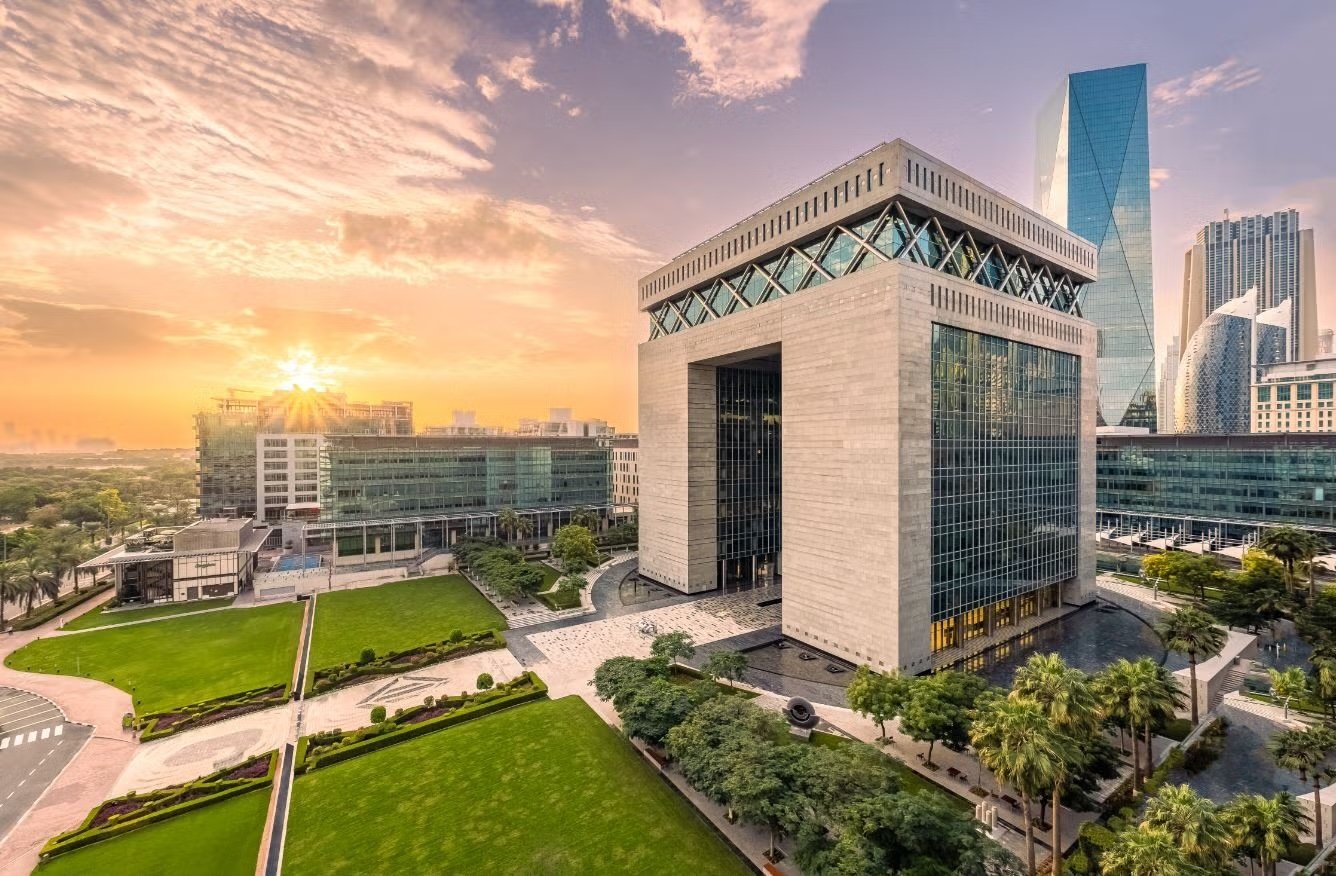
Dubai is not just pulling in wealthy families, it is building density. DIFC says it now holds over 1,250 family-related entities, and it keeps pointing to the scale of assets the top families run inside its ecosystem. That is the real draw. A family office rarely wants to be first into a place. It wants to land somewhere already full of the right banks, lawyers, fiduciaries, and deal flow.
The short version
Why Dubai is winning family offices in 2026:
- Personal tax is still structurally light. No personal income tax, and generally no personal capital gains tax on individuals, which changes the long-term compounding maths.
- DIFC and ADGM give institutional-grade options for governance, succession, and asset holding, built on familiar legal concepts with deep advisory around them.
- Residency is more straightforward than most people expect, including Golden Visa routes in certain categories.
- The migration trend is real. Henley & Partners projected the UAE as the top destination for net inflow of relocating millionaires in 2025.
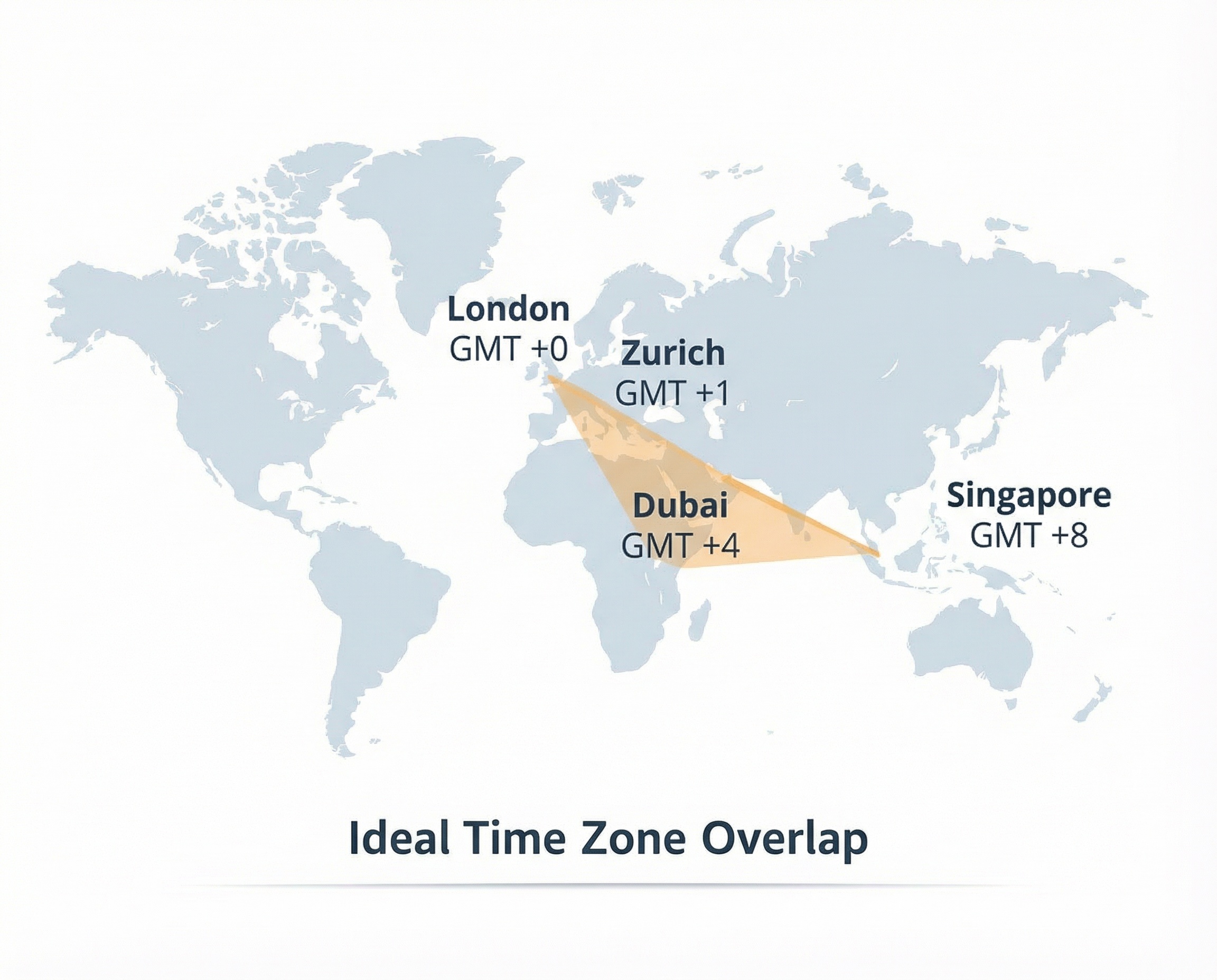
- Time zone, infrastructure, and safety turn a move from a plan into something a family can actually run day to day.
What a family office actually is, and why it changes how they buy property
A family office is the internal team that professionalises what a wealthy family is already doing: investing, governance, succession, reporting, sometimes lifestyle and concierge, sometimes philanthropy, sometimes the operating businesses themselves. Some families run a single-family office for full control. Others build or join a multi-family office to share cost and talent. The line between wealth manager and family office gets blurry, which is normal. As the saying goes, if you have seen one family office, you have seen one family office.
Why does that matter for Dubai property? Because a family office does not buy real estate the way an ordinary investor does. It buys in layers:
- a base layer, for capital preservation: prime assets, trophy or legacy holdings
- a cash-flow layer: stabilised rentals, short-term rental strategies, multi-unit positions
- an optionality layer: development exposure, off-plan allocations, land, strategic districts
That is a big part of why these groups take Dubai seriously. It can be structured, diversified, and managed operationally, with far more liquidity than most emerging-market alternatives.
Reason 1: tax efficiency, with one nuance that matters
The headline is obvious. The UAE levies no personal income tax and, for individuals, generally does not impose capital gains tax the way many Western jurisdictions do. So a family planning across generations sees a very different runway for compounding, transfers, and reinvestment.
The better way to put it: Dubai is less about paying no tax and more about simplifying the stack. Less friction at the personal level, fewer moving parts, and a jurisdiction that has been actively designing policy to attract globally mobile capital.
Now the nuance, and it matters if you are sophisticated about this. The UAE has introduced corporate tax, 0% up to AED 375,000 of taxable income and 9% above that, with special rules depending on the entity type and where income is sourced. That does not cancel the Dubai thesis. It does mean a proper family office structures on purpose rather than casually. This is not a place to wing it. Set the structure up correctly and the system can be unusually efficient.
How Dubai stacks up against the other hubs
High level, and a real family office will model this with advisors. But it shows the logic fast.
| Factor | Dubai (DIFC, ADGM, Mainland) | London | Singapore | Zurich |
|---|---|---|---|---|
| Personal income tax | No personal income tax | High (varies) | Yes | Yes |
| Residency pathways | Golden Visa options in eligible categories | Tightening | Selective | Selective |
| Regulatory ecosystems for private wealth | DIFC Family Wealth Centre, ADGM family office platform | Mature | Mature | Mature |
| Time zone advantage | Overlaps Europe and Asia | Europe-centric | Asia-centric | Europe-centric |
| Real estate market role | Core allocation + growth, high rental demand in key districts | Core allocation | Core allocation | Core allocation |
Here is the slightly uncomfortable part. Families are not choosing Dubai only because it is better. Some are choosing it because other hubs feel more restrictive than they used to, on residency, on scrutiny, on lifestyle. That is not me being dramatic. Henley’s 2025 data shows the UAE leading projected net inflows of relocating millionaires, and that is not a niche trend anymore.
Reason 2: DIFC and ADGM make structure feel normal
Talk to family office people long enough and you notice something. They will say they moved for lifestyle or time zone, but keep asking why here specifically and the conversation always lands on structure.
Not org charts. Legal and operational structure: what vehicles you can use, how predictable the courts and regulators feel, how easily you can hire the right people, and whether the whole setup still works when the founder is no longer around. Dubai has become very good at this, and it did it by building multiple lanes instead of one highway: DIFC, ADGM, and a wider set of mainland and free-zone options that sit alongside them.
DIFC vs ADGM vs DMCC, the simple version
- DIFC reads as a dense, mature private-client ecosystem, a heavy concentration of family-related entities and institutions, plus a family wealth hub story it actively invests in. DIFC reported 1,289 family-related entities and 1,115 foundations in its 2025 annual results, which is a real scale signal.
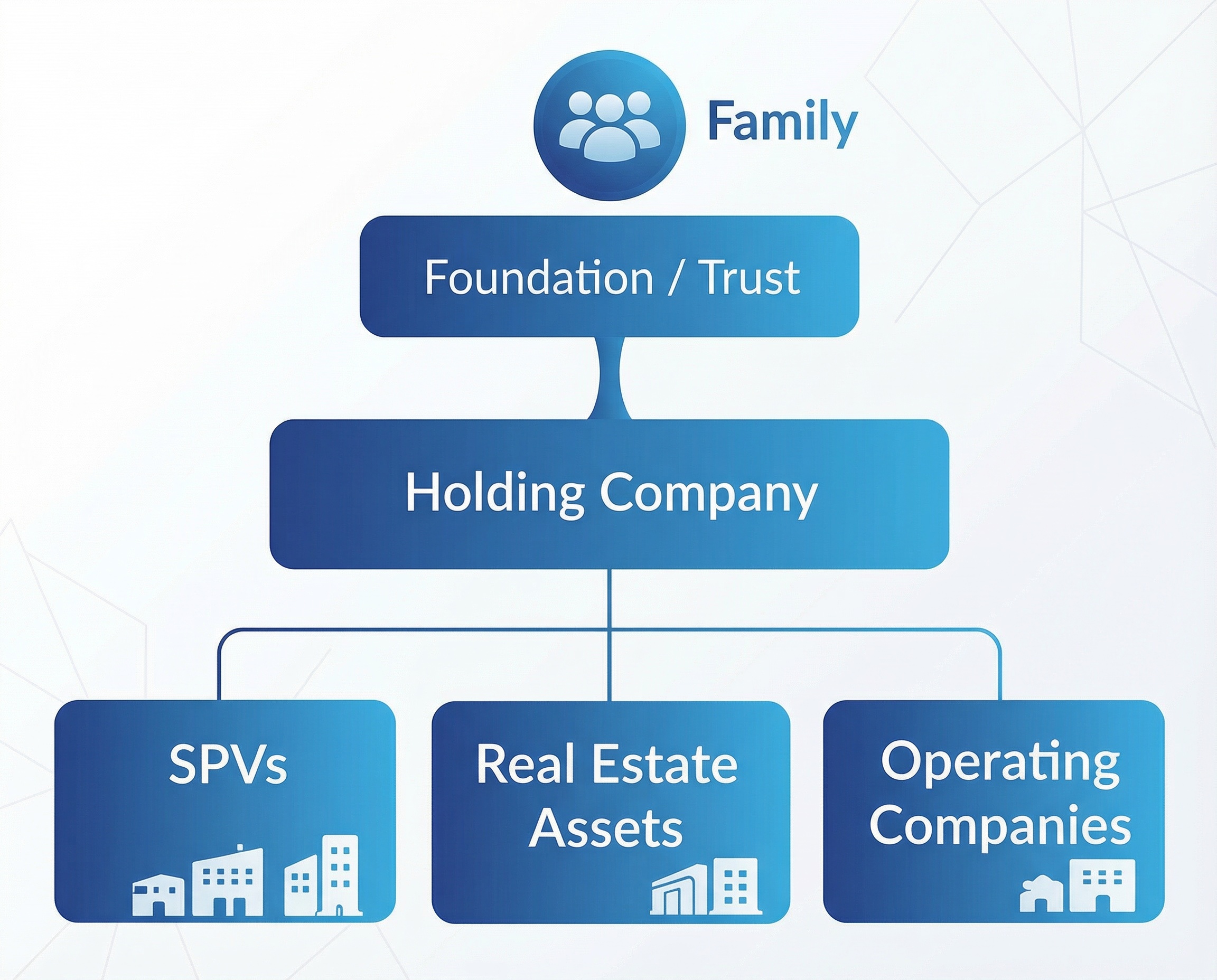
- ADGM reads as a structuring and legal framework platform, especially for families that want foundations, trusts, SPVs, and holding structures leaning on English common law concepts.
- DMCC is often the commercial base, and it has been building wealth-oriented positioning too. The point is that families can separate where the operating company sits from where the wealth structure sits. It is rarely all in one place.
What families are usually optimising for
| Question a family office is really asking | DIFC | ADGM |
|---|---|---|
| “Where can we sit inside a deep private wealth ecosystem?” | Very strong density of private-client institutions and family-related entities, DIFC is explicitly pushing this. | Strong, though often positioned more as a structuring and domicile platform than a financial-district lifestyle hub. |
| “Do we have foundations, trusts, SPVs, holding options?” | Yes, DIFC foundation usage is visibly growing. | Yes, explicitly positioned as core offerings, ADGM also publishes detailed regime guidance. |
| “Is there clear momentum, not just promises?” | DIFC cites scale and growth in family-related entities and foundations, plus big ecosystem expansion plans reported widely. | ADGM’s positioning is consistent and very specific about family offices and structuring. |
Families like optionality. DIFC and ADGM let a family office separate where we operate from where we hold, which matters when the family has operating companies across several countries.
Those big numbers, and why they matter more than they sound
DIFC has stated it holds more than 1,250 family-related entities and that the top 120 DIFC-based families manage over USD 1.2 trillion in assets globally. In its 2025 annual results, DIFC said it is home to 1,289 family-related entities and that DIFC-based families have set up 1,115 foundations, with strong year-on-year growth.
Why care about the counts? Because a family office moving jurisdictions is not only choosing laws, it is choosing counterparties: banks, fiduciaries, auditors, lawyers, trustees, fund administrators, talent, and other families to co-invest with. Density cuts friction. It makes deal flow and hiring feel normal rather than exceptional. That is the quiet advantage.
Golden Visa and residency, the make-it-practical layer
A relocation falls apart when the family cannot actually live there, or when the residency rules feel vague. Dubai’s investor route tied to real estate comes up a lot because it is easy to grasp at a headline level. Dubai Land Department’s Golden Visa investor page lists a property value of AED 2 million as a key requirement, with conditions including that the property may be mortgaged with supporting bank documentation and that the applicant must be inside the UAE at the time of application. The UAE government’s Golden Visa overview sets out the investor categories and documentation, and Abu Dhabi’s platform also references AED 2,000,000 as a real estate threshold, so the “2 million” figure is official, not a rumour doing the rounds on Telegram.
Say it plainly to sophisticated readers: residency is a process, not a vibe. There is documentation, eligibility, and in some cases in-country steps. The point is not that it is effortless. The point is that it is legible.
Corporate tax, the nuance serious families appreciate
Dubai gets flattened into “0% tax,” but the grown-up version is more precise. The UAE’s official corporate tax page states 0% on taxable income up to AED 375,000 and 9% above that. The legislation portal reflects the AED 375,000 threshold in Cabinet Resolution No. 116 of 2022, and the Ministry of Finance frames who can be subject to corporate tax, which helps families separate the personal layer from the corporate one.
Counterintuitively, families often like this. Not because they want to pay more, but because predictable rules cut surprise risk. They can design structures deliberately.
Reason 3: neutral, predictable, safe
People roll their eyes at “safe retreat.” Fair enough, it can sound like sales copy. But read how global institutions describe Dubai and the same themes keep recurring: a neutral stance, regulation that global counterparties recognise, and the sense that you can run complex cross-border operations without constant friction. Reuters, for one, described DIFC’s appeal to global financial institutions partly in terms of its neutral political stance alongside regulation and a safe investment environment.
This matters because family offices are allergic to messy uncertainty. Not just market volatility, but operational uncertainty: will we be able to bank normally, hire, move money, do deals, and live a normal life. Dubai tends to score well on that lived-experience side, which is why families who are already globally diversified still base a team here.
On safety data
I am careful with rankings because they are noisy. Still, Gallup’s Law and Order Index is built around how safe people feel, confidence in the police, and whether they experienced theft or assault, so it tracks the perception layer families actually care about. Regional reporting has also flagged that GCC countries tend to score strongly on walking-alone-at-night measures, which is the everyday safety that counts when a family is relocating rather than visiting.
Reason 4: pro-business setup and execution speed
An underrated Dubai advantage: you can move from intention to execution quickly. If you are standing up entities, opening offices, hiring, and building a footprint, speed matters. The UAE’s official government platform states that foreigners can establish companies with 100% ownership under Federal Decree-Law No. 26 of 2020, and it lays the concept out clearly for mainland structures.
That does not make every activity frictionless. Strategic sectors differ, and licensing still needs good advisors. But the direction is obvious. Dubai wants serious operators, and it wants them to own their businesses.
Reason 5: ecosystem density, the gravity effect
A family office rarely relocates into a vacuum. It relocates into a network. DIFC has been direct about building that density. In its 2025 annual results, published February 2026, it said it is home to 1,289 family-related entities and that DIFC-based families have established 1,115 foundations, both with strong year-on-year growth. In another update it said the top 120 families operating out of DIFC manage above USD 1.2 trillion in assets globally, which is a large part of why the ecosystem keeps compounding.
Dubai is pushing several entry points too. DMCC launched a Wealth Hub positioned as a single front door into Dubai’s private capital environment, referencing family offices, cross-border structures, succession planning, and governance. And for the cleanest macro signal that this is not small, Henley’s Private Wealth Migration Report 2025 puts the UAE among the major destinations in millionaire migration flows. Lifestyle matters, but the ecosystem density is what makes the move stick.
Where real estate fits in
For many of these families, Dubai property is not just an investment. It becomes infrastructure. They use it for:
- Residency optionality. Dubai Land Department’s Golden Visa investor service ties eligibility to a property purchase value of AED 2 million, including conditions around mortgage documentation and being inside the UAE at application. That is why you see families structure a purchase as part of a broader base-in-Dubai plan rather than a standalone flip.
- A tangible allocation inside a global portfolio. Even families heavy in public markets want a layer of tangible, income-producing assets. Dubai runs several demand engines at once, residents, tourism, corporate inflows, and it spans everything from prime trophy holdings to cash-flow apartment blocks.
- Aligning lifestyle and balance sheet. If the family is going to live here, property is a personal decision and a portfolio decision at the same time.
| Real estate role in the portfolio | What families often prefer in Dubai | Why it fits the “Dubai thesis” |
|---|---|---|
| Capital preservation | Prime, liquid districts, higher quality buildings, strong end-user demand | Easier resale, clearer leasing dynamics, less operational drama |
| Income layer | Stabilized rentals, sometimes multi-unit positions, sometimes short-term rental programs | Operationally manageable, cash-flow narrative is easy to report |
| Optionality layer | Select off-plan allocations in high-conviction locations | Structured payment plans, upside exposure, ability to size positions |
At Totality Real Estate we work as a buy-side partner built around portfolio underwriting and execution, not a brokerage that sells units. We start with governance and objectives: what the family is trying to achieve, how it defines risk, what liquidity needs to look like, and what success means over a 3, 5, or 10-year horizon. From there we model downside scenarios, cash flow, service-charge impact, vacancy assumptions, and exit logic, before we shortlist anything that fits the mandate. After acquisition we stay in it, financing coordination, snagging and handover, furnishing and fit-out, leasing strategy, and clean reporting, so the asset ends up operational and portfolio-ready, not just bought.
A 30-to-90-day relocation workflow, high level
- Pick the base, DIFC, ADGM, or a hybrid, based on governance and operating needs.
- Map the entities, holding layer, investment SPVs, operating companies, banking.
- Confirm the residency route, including whether property will be used and any timing steps like in-country requirements.
- Run a tax and substance review, aligning corporate tax exposure correctly, especially for operating companies.
- Build the life layer, schools, housing, healthcare, staffing, so the move sticks.
Families do not leave because a spreadsheet tells them to. They leave when they are confident it will be a better daily life.
Ready property vs off-plan, how families usually decide
| Lens | Ready property | Off-plan |
|---|---|---|
| Primary use | Immediate income, immediate lifestyle, immediate occupancy | Phased capital deployment, upside optionality |
| Risk profile | Lower construction risk, higher “today’s price” risk | Higher execution risk, potentially better entry |
| Best for | Cash-flow layer, base assets | Optionality layer, strategic allocations |
| Due diligence focus | Title, building quality, service charges, tenant demand | Developer track record, escrow, SPA terms, handover timeline |
| Operational demands | Property management, leasing strategy | Progress monitoring, snagging, handover readiness |
This is a decision framework, not a promise of returns.
A simple underwriting template, example inputs
| Input | Example | Notes |
|---|---|---|
| Purchase price | AED 5,000,000 | Use actual signed SPA or title deed value |
| All-in costs | AED 250,000 | DLD fees, agent fees, furnishing, snagging, legal |
| Gross annual rent | AED 350,000 | Use conservative comps |
| Vacancy allowance | 5% | Depends on building and strategy |
| Service charges | AED 45,000 | Confirm building-specific charges |
| Net operating income | AED 287,500 | Gross minus vacancy minus service charges |
| Net yield | 5.5% | Net NOI divided by all-in cost |
| Exit plan | 5 to 10 years | Define trigger, refinance, sell, hold |
We underwrite for forward yield, operationalise fast, and keep reporting clean for portfolio oversight.
What families get wrong when they move to Dubai
- They over-optimise for tax headlines and under-optimise for governance. The personal tax setup is attractive, PwC notes there is currently no personal income tax, no capital gains tax on individuals in that context, and no wealth taxes on individuals. But the bigger long-term win is governance and structure. DIFC and ADGM exist for a reason.
- They set up entities without thinking about corporate tax exposure. The official rates are 0% up to AED 375,000 and 9% above, and the Ministry of Finance describes the regime the same way. A serious family office plans this upfront, especially with operating companies in the mix.
- They buy property before deciding their operating model. Short-term rental, long-term rental, mixed, family use, corporate housing, each is a different operation. Decide the intent first, then buy.
- They underestimate reporting and admin. Dubai makes it easy to move fast, which can leave you with messy structures if you do not keep documentation, board minutes, entity charts, banking KYC, and reporting consistent.
FAQs
Why are family offices moving to Dubai right now?
Because Dubai combines a low-friction personal tax environment, an expanding family wealth ecosystem in DIFC and ADGM, fast business setup, and a lifestyle that makes relocation practical rather than theoretical. DIFC’s recent results show rapid growth in family-related entities and foundations, which signals ecosystem depth.
Is DIFC or ADGM better for a family office?
It depends on priorities. DIFC tends to win on ecosystem density and private-client clustering, while ADGM leans hard into structuring options like SPVs, foundations, trusts, and governance. Many families use both.
Does Dubai really have 100% foreign ownership?
The UAE’s official platform states foreigners can establish companies with full 100% ownership under the relevant law, with practical scope depending on the activity and licensing.
Can a family office get a Golden Visa through property?
Dubai Land Department’s Golden Visa investor service references a property purchase value of AED 2 million or more, with specific terms including mortgage documentation and the applicant being inside the UAE at application.
Is “0% tax” still true in 2026?
For individuals, PwC notes there is currently no personal income tax in the UAE, no capital gains tax on individuals in that context, and no wealth taxes on individuals. For companies, corporate tax applies, with the main rates summarised as 0% up to AED 375,000 and 9% above that, plus extra complexity for certain large multinationals.
What is the biggest real estate mistake family offices make in Dubai?
Buying on marketing instead of an operating plan. The right order is strategy, structure, underwriting, then acquisition, then operations.
Why is Dubai considered “neutral” for global wealth?
Global reporting has described DIFC’s appeal to international institutions partly in terms of Dubai’s neutral political stance, along with regulation and a safe investment environment.
How big is Dubai’s family office ecosystem?
DIFC has stated it holds more than 1,250 family-related entities, cited the scale of assets managed by its top families, and reported rapid growth in foundations. Dubai’s government investment portal also positions the city as a major regional hub for family offices.
If the goal is a Dubai base that actually works, the clean path is simple: define governance, pick the DIFC or ADGM lane or both, underwrite the real estate as part of the operating plan, then execute with reporting built in from day one.