


To buy an off-plan resale in Dubai, you take over an existing buyer’s contract with the developer before the building is handed over. You agree a price with the seller, confirm what has been paid and what is still owed, get the developer’s No Objection Certificate (NOC), and register the transfer with the Dubai Land Department (DLD) through a registration trustee. From that point the Sale and Purchase Agreement (SPA) and every remaining instalment are yours.
That is the mechanism. The reason to bother is price. A developer can hold its launch price for years. An individual owner facing a payment call cannot. The developer’s price list is not the lowest price for exposure to a project, and in the current market the gap between the two can be large. It can also be fake, which is what most of this guide is about.
For the investment logic behind assignments, read our full off-plan assignment playbook; this guide covers the transaction itself.
On this page
- What is an off-plan resale in Dubai?
- Why some resales sell below original price
- How to buy one, step by step
- How much cash do you need?
- Worked example: 30% below OP
- Fees and hidden costs
- How to verify a distressed property
- Can you get a mortgage?
- Risks, and how to protect yourself
- Resale vs buying direct from the developer
- Who should buy, and who should not
- Frequently asked questions
The process in brief
- Find a unit priced at least 10% below OP and below recent DLD sales of comparable units.
- Get a fresh Statement of Account from the developer showing what has been paid, any arrears and the balance.
- Confirm the developer’s resale threshold and NOC fee in writing.
- Sign Form F, conditional on the NOC, with a deposit of around 10%.
- The seller obtains the NOC, usually in five to seven working days.
- Complete at a trustee office: pay the seller, any amount due to the developer, the 4% DLD fee and costs, and collect the new Oqood in your name.
- Pay the remaining instalments to the developer on the original schedule.
Budget 6% to 7% of the price in costs on top of the price itself.
What is an off-plan resale in Dubai?
An off-plan resale (also called an assignment, or a pre-registered sale) is the purchase of an unfinished unit from someone who already bought it from the developer. You are not buying a title deed, because none exists yet. You are buying the seller’s position under the SPA: their right to receive the unit at handover, and their obligation to pay what remains.
Dubai records these positions in the Interim Real Estate Register under Law No. 13 of 2008. The law allows a registered off-plan unit to be sold, and makes any sale that is not entered in the register void. The registration is known as Oqood. When the transfer completes, DLD issues a new Oqood in your name, usually within a day or two. That registration is your proof of ownership until handover, when it converts to a title deed.
Three parties have to agree, not two. The seller and buyer agree price and terms. The developer has to consent, which it does by issuing an NOC once the unit’s account meets the conditions in the SPA. DLD’s own guidance is that resale is possible after the developer issues that NOC. DLD then registers the change.
A simple example. An investor booked a two-bedroom at AED 2,000,000 and has paid AED 600,000 (30%). The remaining AED 1,400,000 is due to the developer in instalments and at handover. You agree to pay the investor AED 500,000 and take over the AED 1,400,000. Your effective price is AED 1,900,000, 5% under the original. The investor takes a AED 100,000 loss to exit. The developer collects exactly what the SPA already said it would, just from you.
The difference from a completed-property resale is that you inherit construction risk, a payment schedule and a handover date you do not control. A ready resale gives you a title deed, a unit you can inspect and, usually, a mortgage on normal terms.
Why some Dubai off-plan resales sell below original price (OP)

Developers rarely cut list prices. In fäm Properties’ analysis of 717 off-plan projects launched since July 2023, reported by Khaleej Times on 30 September 2026, 44 projects (about 6%) had cut prices by 5% or more since the end of February 2026, and 28 (about 4%) were selling below their original launch price. More than 90% had held their launch prices. The adjustment is showing up in slower sales rather than lower price lists.
Be careful what those numbers mean. They measure developer pricing. They say nothing directly about what individual owners accept. The two can move very differently: a developer with unsold stock can wait, or offer a payment plan instead of a discount, while an owner with a 40% instalment due next month has neither option.
Resale activity has also thinned. Cavendish Maxwell’s Q1 2026 residential report put off-plan resales at 8.3% of off-plan transactions, down from 15.7% a year earlier. Fewer buyers in the secondary off-plan market means motivated sellers have fewer exits, and price is the lever they have left.
Individual sellers are where the real discounts sit. Our distress-deal scanner tracks resale listings posted across Dubai broker networks every day. On 29 October 2026 it held about 540 live Dubai listings priced 10% to 30% below original price, 343 of them off-plan. Across the full set, roughly 326 are 10% to 15% below, 128 at 15% to 20%, 71 at 20% to 25% and 16 at 25% to 30%. A sample from October:
Scroll to see all columns →
| Project | Area | Developer | Unit | Asking (AED) | Original price (AED) | Below OP |
|---|---|---|---|---|---|---|
| Natuzzi Harmony Residences | Dubai Islands | Peace Homes | 2BR, 1,425 sq ft | 2,350,000 | 3,227,755 | 27.2% |
| Damac Bay 2 (Cavalli), Tower A | Dubai Harbour | DAMAC | 1BR, 776 sq ft | 2,450,000 | 3,150,000 | 22.2% |
| Seapoint 2 | Emaar Beachfront | Emaar | 2BR, 1,430 sq ft | 4,250,000 | 5,450,000 | 22.0% |
| Chelsea by Damac | Dubai Maritime City | DAMAC | 1BR, 776 sq ft | 1,900,000 | 2,400,000 | 20.8% |
| Sobha Hartland II | Sobha Hartland 2 | Sobha | 756 sq ft | 1,400,000 | 1,766,404 | 20.7% |
| Samana Portofino | Dubai Production City | Samana | Studio, 410 sq ft | 600,000 | 750,000 | 20.0% |
| Nautica Two | Dubai Maritime City | Select Group | 2BR, 1,034 sq ft | 2,250,000 | 2,800,000 | 19.6% |
| Viewz 2 | JLT | Danube | 1BR, 738 sq ft | 1,300,000 | 1,585,000 | 18.0% |
| Albero | Dubai Creek Harbour | Emaar | 3BR, 1,848 sq ft | 3,800,000 | 4,486,888 | 15.3% |
| Anwa Aria | Dubai Maritime City | Omniyat | 1BR, 935 sq ft | 2,100,000 | 2,450,000 | 14.3% |
| Club Drive | Dubai Hills Estate | Emaar | 2BR, 1,085 sq ft | 2,247,000 | 2,595,888 | 13.4% |
| Hills Edge, Tower B | Dubai Hills Estate | Emaar | 2BR, 1,139 sq ft | 2,660,000 | 2,958,888 | 10.1% |
These are asking prices, with the original price as stated by the listing agent and any DLD fee stripped out. They are not completed transactions, some units are listed by more than one agent, and none is verified against its SPA until someone does the work in Steps 2 to 5. That work is the point: listings claiming 2% to 5% off are not distress, because transfer costs alone wipe that out. Our floor is 10% below OP, and the deals worth moving on fast are usually 15% and up.
Not every discount comes from distress, and the reason matters more than the percentage. I sort them into four groups:
- Genuine distress. The seller cannot or will not fund the next instalments. Pricing moves quickly and the seller cares about certainty more than headline price.
- Normal negotiation. The seller wants out and prices a little under the market to sell faster. Small discount, often fair.
- The seller overpaid. They bought at a launch price that was above the area’s real market. Their “discount” brings the unit back toward fair value. You are not getting a deal, you are avoiding their mistake.
- The market fell. Values in that project or sub-market have dropped since launch. A 15% discount to original price in a project that has fallen 20% is an overpayment.
A resale priced below the seller’s original price is not, by itself, evidence of value. The only test that counts is your total cost against what comparable units actually transact for.
How to buy an off-plan resale in Dubai, step by step

Step 1: Identify resale opportunities
Portals show some assignments, but the motivated ones often move before they are listed. Sellers under payment pressure call brokers they know, and units trade inside broker networks and private channels within days. In my view this is what distinguishes the current cycle from earlier corrections: Dubai has real end buyers, so a genuinely good distressed unit gets taken quickly. Being early and being ready with funds matters more than being on every portal.
Specialist brokers find these through developer collections teams, repeat price reducers on the portals, and owner networks. Whatever the source, the unit only becomes an opportunity after Steps 2 to 5.
Step 2: Verify the property and the seller
Ask for the SPA, the Oqood certificate and the seller’s passport or Emirates ID. The names, unit number, area and contract value must match across all three. Check the project on the DLD’s Dubai REST app or the DLD website for its registration and construction status, and confirm the project has a registered escrow account. Under Law No. 8 of 2007, every off-plan payment has to go into that account, which is reserved for building the project.
Check the broker too. Every broker in Dubai needs a valid RERA card, and the seller should have signed a Form A listing agreement with them. If someone claims to represent a seller and cannot show Form A, you do not yet know who you are dealing with.
Step 3: Confirm how much the seller has paid
This is the step most buyers get wrong. Do not rely on the seller’s receipts or a spreadsheet. Ask the seller to request a current Statement of Account (SOA) from the developer, dated within the last few days. The SOA shows the contract value, every payment received, any overdue instalments, late-payment charges, and the schedule still to come.
Read three numbers off it: the percentage paid, any overdue amount, and the total still owed. Those three numbers drive everything that follows, including the developer’s consent and your own cash requirement. If the seller hesitates to get an SOA, treat it as a red flag.
Step 4: Establish the real discount
The seller’s original price is the least useful number in the deal. Build your own comparison:
- the seller’s contract value and the resale price you are being offered,
- the developer’s current price for comparable units in the same project, if any remain,
- recent DLD-registered transactions for comparable units in the project and nearby,
- your full acquisition cost, including DLD, trustee, NOC and commission, divided by the unit’s area.
Price per square foot only works when units are comparable. Adjust for floor, view, layout and whether the unit is furnished. If your all-in cost per square foot is not clearly below what comparable units actually trade at, the discount is cosmetic. Our assignment playbook goes deeper on entry price versus market value, and the September 2026 market report gives the current transaction backdrop.
Step 5: Confirm assignment eligibility
Developers only allow resale once a set share of the contract has been paid. That threshold sits in the SPA or the developer’s resale policy, and DLD sets no statutory minimum. It varies by developer, by project and sometimes by launch phase. Ellington, for example, publishes a 30% standard and 50% plus the next instalment on ten named projects. Emaar was reported in 2013 to require 40% on some projects. Market guides commonly cite 30% to 40%, but the only number that counts is in your clause.
Ask the developer, through the seller, for written confirmation of four things: the minimum paid percentage, whether any overdue amount must be cleared first, the NOC fee and any separate transfer or admin fee, and any restriction on the unit (a payment-plan discount that is clawed back on resale, for example).
If the seller is below the threshold, the deal does not die, but it changes. Someone has to pay the developer enough to reach it before the NOC is issued. That is usually the buyer, with the money credited against the price, and it has to be structured so you are protected if the transfer then fails. The worked example below shows both ways to do it.
Step 6: Agree a conditional purchase structure
In Dubai the buyer and seller sign Form F, DLD’s unified sale contract, which works as the memorandum of understanding for the sale. It records the price, the deposit, who pays which fees, the completion date and what happens if things go wrong. The buyer’s broker signs a Form B with the buyer.
Write conditions into Form F, not into a WhatsApp thread. At minimum: the deal is conditional on the developer issuing the NOC; the price is based on the SOA amounts stated in the contract; overdue amounts are the seller’s responsibility unless agreed otherwise; and the deposit is refundable if the developer refuses consent for reasons outside your control. By market convention the deposit is around 10% of the price, often held by the brokerage as a security cheque. On a resale where most of the price goes to the developer, agree whether the 10% is measured on the full price or on the seller’s share.
This is also the window where deals break. The developer recalculates dues and finds late fees the seller did not mention. The seller misses an instalment while waiting. The NOC expires before the trustee appointment. A higher offer arrives. Every one of those has to be covered by a clause, a date or a deposit term in Form F.
Step 7: Obtain the developer NOC
The seller applies for the NOC, because it is the seller’s account, often now through Dubai REST. The developer checks that the paid threshold is met and arrears are cleared, collects its fee, and issues the NOC. Published fees include AED 5,250 at Ellington and AED 4,000 plus VAT at Select Group; market guides put the range at about AED 500 to AED 5,250.
Processing usually takes five to seven working days (Select Group quotes six). An NOC is typically valid for around 30 days, so book the trustee appointment as soon as it lands.
Step 8: Complete the registered transfer
The transfer happens at a DLD-licensed registration trustee office (or through DLD’s digital channels where available). Both parties or their attorneys attend, with original IDs, the NOC, the SPA and the Oqood. Payments are made by manager’s cheque or the trustee’s approved method: the seller’s payment to the seller, DLD’s fees to DLD, and any amount due to the developer to the developer.
Before you leave, confirm DLD has issued the new Oqood in your name. That document, not the receipt, is your evidence of ownership.
Step 9: Confirm your obligations as the new buyer
Within a week, get an updated SOA from the developer in your name. Check the remaining schedule matches what Form F assumed, update your contact details for payment notices, and diarise every instalment and the expected handover. If you plan to finance the handover payment, start the mortgage conversation now, not two weeks before it falls due.
Documents to request before you commit
| Document | What it proves |
|---|---|
| SPA (signed, all pages and addenda) | Contract value, payment plan, resale clause, handover terms |
| Oqood certificate | The seller is the registered owner |
| Developer Statement of Account (recent) | Amount paid, arrears, remaining schedule |
| Developer resale policy or written confirmation | Paid threshold, NOC and transfer fees |
| Seller ID (passport or Emirates ID) | Identity matches the Oqood |
| Form A and broker RERA card | The broker is authorised to sell |
| DLD project status (Dubai REST) | Registration, escrow and construction progress |
How much cash do you need to buy an off-plan resale?
You do not pay the agreed price to the seller on day one. The agreed price is a total, and it splits into parts that fall due at different times.
| Part | Paid to | When |
|---|---|---|
| Seller’s equity (what they paid, minus their discount) | Seller | At transfer |
| Arrears or top-up to reach the developer’s threshold | Developer | Before or at transfer |
| Remaining instalments and handover payment | Developer | On the SPA schedule |
| DLD transfer fee and admin charges | DLD | At transfer |
| Trustee office fee + VAT | Trustee | At transfer |
| Developer NOC and transfer fees + VAT | Developer | Before transfer |
| Brokerage commission + VAT | Broker | At transfer |
Your initial liquidity is every row except the third. Your total commitment adds the third. Confusing the two is how buyers end up defaulting on a unit they bought cheaply.
The share of the price you pay at transfer depends almost entirely on how far through its payment plan the unit is. Early-stage units, where the seller has paid 20% to 40% and the rest falls due over two or three years, need far less cash upfront. Units close to handover have most of the price already paid in, so the seller’s equity is large and you need most of the money at once.
That is why buyers with roughly AED 500,000 to AED 1,000,000 of available cash can buy into some resales priced at well over a million. The cash covers the seller’s equity and the costs, and the rest is paid on the developer’s schedule. It does not mean that budget opens every deal, and it does not mean the remaining instalments are optional. Before you agree anything, map every future payment against money you can show will be there.
Worked example: buying an off-plan resale 30% below OP
Discounts of this size are not hypothetical. On Dubai Islands, some distressed off-plan units have traded well below their original price. The worked example below uses round numbers at that level of discount to show how such a deal is structured. It is an illustration, not a specific unit or an offer, and any real transaction has to be checked against its own SPA, the developer’s SOA and the NOC.
The numbers
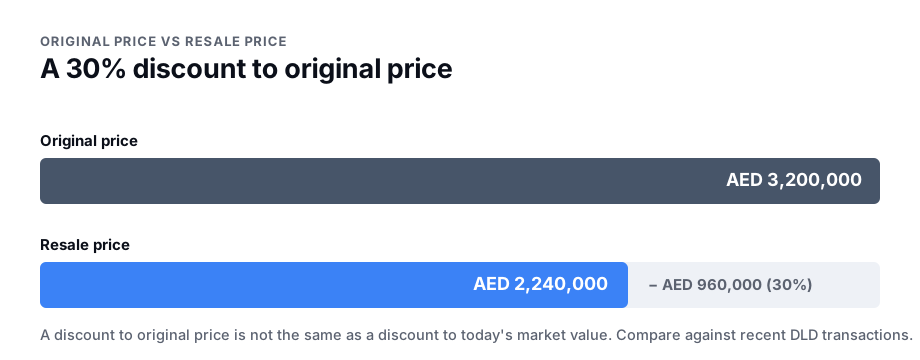
The unit: an illustrative two-bedroom on Dubai Islands, 1,425 sq ft, bought from the developer at AED 3,200,000 and offered at 30% below OP.
| Item | AED |
|---|---|
| Original contract price | 3,200,000 |
| Agreed resale price (total) | 2,240,000 |
| Difference | 960,000 (30%) |
| Paid to developer by seller (38%) | 1,216,000 |
| Due to developer before resale (42%) | 1,344,000 |
| Due to developer at handover (20%) | 640,000 |
Where the money goes
The resale price of AED 2,240,000 is the buyer’s total price for the unit, including what is still owed to the developer. Here 62% of the contract (AED 1,984,000) remains unpaid to the developer: the 42% due before resale and the 20% due at handover.
That leaves AED 256,000 for the seller (2,240,000 minus 1,984,000). The seller paid AED 1,216,000 and walks away with AED 256,000, a loss of AED 960,000. The seller’s loss equals the headline discount, which is how you know the numbers are not double-counted.
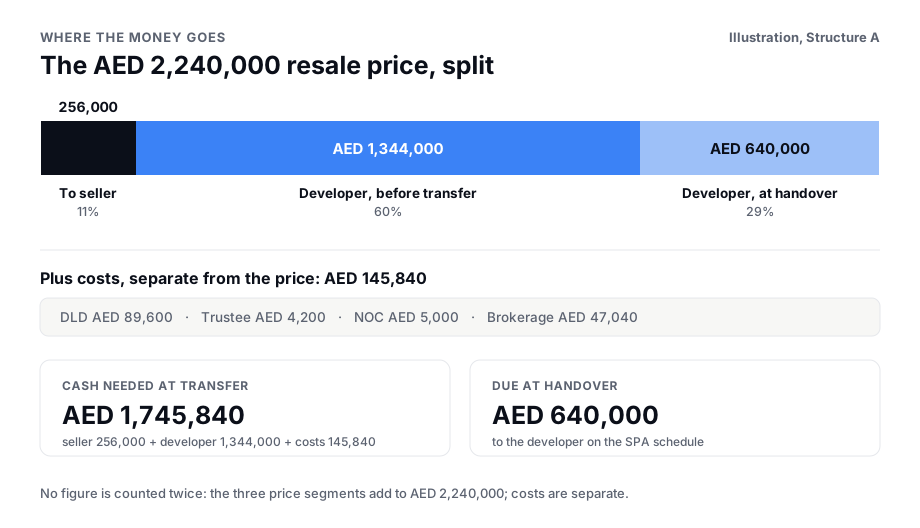
Who pays the 42% changes the risk, not the buyer’s cash. There are two ways to do it:
- Structure A, buyer funds the 42% at transfer. You pay AED 256,000 to the seller and AED 1,344,000 to the developer on transfer day. This only works if the developer will issue the NOC against payment at the trustee office. If the developer insists on receiving the 42% before it issues the NOC, your money reaches the developer while the unit is still in the seller’s name. Do not do that without a written developer confirmation and an agreed refund mechanism.
- Structure B, seller pays the 42% first. The seller tops up to 80%, the developer issues the NOC, and you pay the seller AED 1,600,000 at transfer. The seller has to find AED 1.34 million, which a distressed seller often cannot.
Either way, the buyer pays AED 1,600,000 to the seller and developer combined before handover, plus costs, and AED 640,000 at handover.
Costs, using the market-practice basis for the DLD fee explained in the fees section below:
| Cost | Basis | AED |
|---|---|---|
| DLD transfer fee | 4% of AED 2,240,000 resale price, paid by buyer | 89,600 |
| Trustee office fee | AED 4,000 + 5% VAT, paid by buyer | 4,200 |
| Developer NOC | Assumed AED 5,000 | 5,000 |
| Brokerage | 2% + 5% VAT on resale price | 47,040 |
| Total costs | 145,840 |
| Summary | AED |
|---|---|
| Cash needed at transfer (1,600,000 + 145,840) | 1,745,840 |
| Due at handover | 640,000 |
| Total acquisition cost | 2,385,840 |
| All-in cost per sq ft | 1,674 |
| Original cost per sq ft | 2,246 |
Small DLD admin charges (tens of dirhams) are left out. If DLD registered the transfer at the original contract value rather than the resale price, the DLD fee would be AED 128,000, adding AED 38,400. Confirm the registered value with the trustee before the appointment.
This deal needs about AED 1.75 million in cash at transfer and another AED 640,000 shortly after, because the unit is nearly paid up. It is not an AED 750,000 deal. A large discount on a near-complete unit is a cash buyer’s trade. For current resale stock in the area, see our Dubai Islands distressed deals page.
A smaller ticket: the AED 920,000 studio
Take a studio bought at AED 1,041,317 and offered at AED 920,000, a discount of AED 121,317 (11.65%). Assume, for illustration only, the seller has paid 40% (AED 416,527) and the remaining 60% (AED 624,790) falls due over construction and at handover.
| Item | AED |
|---|---|
| To seller (920,000 minus 624,790) | 295,210 |
| Seller’s loss (416,527 minus 295,210) | 121,317 |
| DLD 4% of 920,000 | 36,800 |
| Trustee AED 4,000 + VAT | 4,200 |
| NOC (assumed) | 5,000 |
| Brokerage 2% + VAT | 19,320 |
| Cash needed at transfer | 360,530 |
| Remaining to developer on schedule | 624,790 |
An investor with AED 750,000 could complete this transfer and keep about AED 390,000 in reserve toward the instalments, with the handover balance financed or paid from savings.
Discount is not return
The discount tells you what the seller lost. Your return depends on your total cost against your exit. In the two-bedroom example, your break-even sale price after handover is your AED 2,385,840 plus roughly 2.1% in selling costs (commission plus VAT), about AED 2,435,900, or roughly AED 1,709 per sq ft, before service charges and holding costs. Whether that is a good trade depends on what comparable Dubai Islands units actually transact for, which you check in Step 4, not on how much the seller lost.
Dubai off-plan resale fees and hidden costs
Budget roughly 6% to 7% of the resale price on top of the price itself, before any arrears. On the two examples above, costs came to 6.5% and 7.1%.
Scroll to see all columns →
| Cost | Amount | Paid to | Who pays in practice |
|---|---|---|---|
| DLD transfer fee | 4% of the sale contract value | DLD | Buyer |
| DLD admin charges | AED 20 (knowledge and innovation fees) per DLD; some developers quote AED 40 for off-plan | DLD | Buyer |
| Trustee office fee | AED 4,000 + VAT at AED 500,000 and above; AED 2,000 + VAT below | Registration trustee | Buyer, unless negotiated otherwise |
| Developer NOC | About AED 500 to AED 5,250 (+ VAT where charged) | Developer | Seller, usually; negotiable |
| Brokerage | 2% of the price + 5% VAT, by convention | Broker | Buyer |
| VAT on the price | None. Residential resales are VAT-exempt; VAT applies to the fees above | n/a | n/a |
| Arrears and late fees | As shown on the SOA | Developer | Seller, unless Form F says otherwise |
| Mortgage registration (if you finance at handover) | 0.25% of the loan + admin | DLD | Buyer |
DLD’s fee schedule, Executive Council Resolution No. 30 of 2013, sets the transfer fee at 4% of the value of the sale contract. In Dubai the buyer pays it, and the seller’s original 4% is not credited. You pay it again.
What the 4% is charged on. This is where most guides go vague. DLD publishes no separate fee page for off-plan resales, and its pages say only “sale value.” In market practice the fee is calculated on the resale price, meaning the full price you contract at, including the balance still owed to the developer, not just the cheque to the seller. That is the basis used in the examples above. On a resale priced below original, confirm with the trustee which value will be registered before you sign Form F, because the difference can run to tens of thousands of dirhams.
DLD fees and brokerage cannot be financed. They come out of your cash. The rest of the line-by-line costs of buying in Dubai are in our full cost guide.
How to verify a genuinely distressed off-plan property
A real distressed opportunity passes on three axes at once: the price is below what comparable units transact for, the paperwork is clean, and you can carry the remaining payments. Score each deal on the questions below before you negotiate.
Scroll to see all columns →
| Check | Proceed | Negotiate harder | Walk away |
|---|---|---|---|
| All-in cost vs recent DLD comparables | 10%+ below | 0% to 10% below | At or above |
| Original price vs area median at launch | At or below | Up to 15% above | Far above (seller overpaid) |
| Developer price for remaining stock | Above your all-in cost | Similar | Below your all-in cost |
| Construction progress vs handover date | On track | Minor delay | Stalled or unregistered escrow |
| Developer track record | Delivered comparable projects | Limited history | Unresolved delays |
| SOA and seller documents | Clean, recent | Small arrears to clear | Refused or inconsistent |
| Remaining payments vs your cash | Fully covered | Covered with financing | Not covered |
| Net rental yield (after service charges) | Meets your target | Marginal | Below your cost of money |
| Total exit cost if you resell | Priced in | Estimated | Unknown |
The thresholds are my working rules, not market standards. Adjust them to your own cost of capital. The point is that every row has to clear, and a large discount on one row does not rescue a failure on another. A 20% discount on an inflated launch price can still leave you paying more than the unit next door sold for last month.
Can you get a mortgage for an off-plan resale in Dubai?
Sometimes, and less often than buyers assume. UAE Central Bank rules cap lending on off-plan property at 50% of value, and banks lend only on developers and projects they have approved, usually once construction is well advanced. Emirates NBD has been reported to finance off-plan resales from approved developers at 40% completion or more; Mashreq’s threshold has been reported at 35%. Assignments add another layer, because the bank has to accept a resale price that may sit far below the original SPA value.
In practice, most buyers fund the transfer in cash and finance the handover payment. Once the unit is complete and the title deed is issued, the Central Bank’s standard limits apply: for expatriates buying a first home, up to 80% of value up to AED 5 million and 70% above that; for UAE nationals, 85% and 75%. A bank values the completed unit itself, so a buyer who paid a low resale price may find the valuation helps.
What determines whether you can borrow: the project’s construction stage and whether the bank has approved the developer, the bank’s appetite for that area, your residency, income and credit profile, the valuation, and the timing of your transfer relative to handover. Get a pre-approval before Form F if any part of your plan depends on borrowing.
Risks of buying an off-plan resale, and how to protect yourself
Scroll to see all columns →
| Risk | What happens | How to protect yourself |
|---|---|---|
| Developer refuses assignment | Seller is below threshold or has arrears; no NOC | Get written developer confirmation before paying a deposit; make Form F conditional on the NOC |
| Unpaid seller instalments | Arrears and late fees appear at NOC stage | Price off a fresh SOA; state in Form F that arrears are the seller’s |
| Delayed handover | Your capital sits idle longer; rent starts later | Check construction progress on Dubai REST; model a 6 to 12 month delay |
| Developer or project failure | Construction stalls | Confirm escrow registration; favour developers with delivered projects |
| Payments to the wrong account | Money leaves escrow protection | Pay instalments only to the project’s escrow account named by the developer |
| Defective documents | Names or values do not match | Cross-check SPA, Oqood and ID before Form F |
| Unexpected payment calls | Construction-linked instalment falls due early | Map every SPA trigger, not just dates |
| Valuation gap | Bank values below your plan | Get a valuation or pre-approval early |
| Unreliable rent assumptions | Yield misses target | Use transacted rents and real service charges for the building |
| Overstated discount | Seller’s price was above market | Compare against DLD transactions, not the original price |
| Contract dispute | Seller withdraws or delays | Detailed Form F with deposit terms and completion date |
| Financing failure | Handover payment cannot be funded | Hold a reserve; secure pre-approval before committing |
| Restricted exit | Thin resale market for that project | Check recent resale volume in the project before buying |
Off-plan resale vs buying off-plan direct from the developer
Scroll to see all columns →
| Factor | Off-plan resale | Direct from developer |
|---|---|---|
| Purchase price | Negotiable; can be below launch price | List price, rarely cut |
| Discounts | From individual sellers | Usually payment-plan incentives instead |
| Negotiating leverage | Higher when the seller faces a payment | Low |
| Inventory | One specific unit | Choice of floor, view, layout |
| Payment plan | Remaining schedule only | Full plan from booking |
| Upfront cash | Seller’s equity plus costs | Booking deposit (often 10% to 20%) plus DLD |
| DLD fee | 4% on the transfer | 4% on purchase (sometimes developer-paid as an incentive) |
| Other fees | NOC, trustee, brokerage | Fewer |
| Financing | Harder before handover | Same off-plan limits; some developers have bank partners |
| Assignment risk | NOC and threshold must be cleared | None |
| Incentives | None | Waived DLD, post-handover plans |
| Exit flexibility | Already past the developer’s threshold | Must reach the threshold before reselling |
Buying off-plan direct from the developer is the better call when you want a specific unit type (see the developer launches we track), the longest payment plan or a developer incentive that a resale cannot match. The resale is better when the seller’s discount, net of the extra costs, puts your all-in price clearly below both the developer’s current list and recent transactions.
Who should buy below-OP resales, and who should not
The buyers who do well here have cash ready and can decide within days. Good units rarely last a week. With AED 500,000 to AED 1,000,000 available you can reach a real share of early and mid-stage units, provided the remaining instalments are covered. Long-term holders get a lower entry for rental income, and experienced buyers who already understand construction and payment-plan risk get the widest choice.
Skip it if you need a mortgage to complete the transfer, if paying future instalments depends on reselling first, or if this is your first purchase and you cannot read an SPA or get independent advice. If a deal only works when everything goes to schedule, it is not a deal.
Frequently asked questions
Can I buy an off-plan property from an existing owner in Dubai?
Yes. Once the owner has paid the share of the contract the developer requires, the developer can issue an NOC and DLD registers the transfer of the SPA to you. You take over the remaining payments and receive the unit at handover.
Is buying an off-plan resale legal in Dubai?
Yes, provided it goes through DLD. Law No. 13 of 2008 allows a registered off-plan unit to be sold, and the sale counts once DLD records it in the Interim Real Estate Register with the developer’s consent. An unregistered side agreement to “buy” a unit is not a transfer and gives you little protection.
How much cash do I need?
Enough to pay the seller’s equity, any arrears or top-up the developer requires, and transfer costs of roughly 6% to 7% of the resale price. On an early-stage unit that can be a third of the price or less. On a unit near handover it is most of the price.
Do I pay the 4% DLD fee again?
You do. Every transfer is a new registration, so the 4% DLD transfer fee is charged on the resale even though the first buyer paid it on the original purchase. In market practice it is calculated on the full resale price, including the balance still owed to the developer, and the buyer pays it.
Can I buy below the original developer price?
Often, but the discount almost always comes from a seller, not the developer. In fäm Properties’ analysis of 717 projects, only about 4% were selling below their own launch price as of September 2026, while our own scanner showed about 540 resale listings in Dubai at 10% to 30% below OP at the end of October.
What does an off-plan assignment mean?
It is the transfer of an off-plan buyer’s rights and obligations under the SPA to a new buyer before handover. “Assignment,” “off-plan resale” and “pre-registered sale” describe the same transaction.
How much does the seller need to have paid?
Whatever the SPA or the developer’s resale policy states. Thresholds of 30% to 40% are common, some premium projects require more, and there is no single legal minimum. Confirm it in writing from the developer.
Can the developer refuse a resale?
It can, if the unit has not reached the paid threshold, has unpaid arrears, or the SPA restricts resale. The consent requirement comes from the SPA rather than from DLD, so read the resale clause and make Form F conditional on the NOC.
How do I verify the seller’s payments?
Ask for a Statement of Account issued by the developer within the last few days, ideally sent by the developer to both parties. Check it against the SPA payment plan and confirm the NOC application reflects the same balance.
Can I mortgage an off-plan resale?
Only in some cases. UAE Central Bank rules cap off-plan lending at 50% of value and many banks lend only on approved, well-advanced projects. Most buyers pay the transfer in cash and finance the handover payment.
What happens to the remaining installments?
They become yours. You pay them to the developer, into the project’s escrow account, on the dates or construction milestones in the original SPA.
How long does the transfer process take?
Typically one to three weeks from signed Form F, most of it waiting for the developer’s NOC, which usually takes five to seven working days. The registration itself is a single trustee appointment, and the new Oqood normally follows within a day or two.
Can non-residents buy an off-plan resale?
Yes, and you do not need a UAE visa. Law No. 7 of 2006 lets foreign buyers own freehold property in Dubai’s designated freehold areas. You need a valid passport, and remote completion through a power of attorney is possible.
What if the developer delays handover?
You inherit the delay along with the contract. Check the SPA’s completion clause and any compensation terms before buying, and model a 6 to 12 month delay in your numbers.
This guide is general information, not legal, tax or financial advice. Fees, developer resale policies and bank lending criteria change and differ by contract. The worked examples are illustrations built on stated assumptions, not offers. Verify every figure against the SPA, the developer’s Statement of Account and DLD before committing, and take independent advice. Investment outcomes vary.
Sources: Law No. 13 of 2008 · Law No. 8 of 2007 · Law No. 7 of 2006 · Executive Council Resolution No. 30 of 2013 · DLD property sale registration · DLD FAQs · CBUAE mortgage regulations · Khaleej Times on fäm Properties, 30 Sep 2026 · Cavendish Maxwell Q1 2026 · Ellington resale FAQ · Select Group NOC · Khaleej Times on off-plan bank financing, 26 Aug 2026
Totality Real Estate | RERA licensed